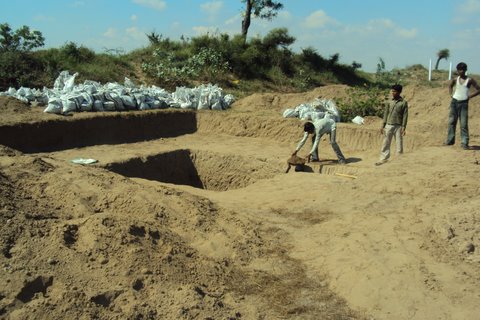
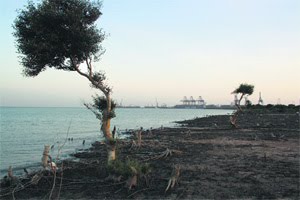
Please sign the online petitions below to express your solidarity and support for the actions proposed by the Environment Ministry in the show cause notices
Petition for action against Mundra Port and SEZ
Petition for action against OPG Power Project

* If you face any difficulty in signing the petitions, please mail us on mass.kutch@gmail.com

Friday, December 17, 2010

MoEF sends a showcause to Mundra Port and SEZ

Proposed OPG power plant in Mundra also gets notice
Express News Service Posted online: Fri Dec 17 2010, 00:11 hrs
Ahmedabad : Proposed OPG power plant in Mundra also gets notice

The Union Ministry of Environment and Forests has issued a showcause to the Mundra Port and Special Economic Zone (MPSEZ) located in Mundra taluka of Kutch district for violating the Coastal Regulation Zone notification of 1991 and asked state authorities to raze constructions that flout CRZ norms within four weeks.

The MoEF has also simultaneously issued showcause to OPG Power Gujarat Private Limited located in Mundra taluka, which is planning a 300-MW thermal power plant about 20 kms from the MPSEZ, for violation of the Environment Impact Assessment Notification, 2006.

The notices follow a site visit by additional director of the MoEF A Senthilvel on December 6 and 7 and the report he submitted.

The MoEF had earlier received several representations alleging violations of various environmental laws from Bharat Patel, general secretary of the Machikar Adhikar Sangharsh Sangathan, a local fishermen’s union.

The notice to the MPSEZ, operated by the Adani Group and valued at MoEF sends a showcause to Mundra Port and SEZ

Rs 29,610 crore in terms of market capitalisaion, lists several CRZ violations that include “large-scale” destruction of mangroves in different areas, blocking of creeks and tidal flow to mangrove areas, and building an airport, a township and a hospital without proper clearances.

The airport had obtained clearance from the Civil Aviation ministry, but had not obtained one from the MoEF, which is mandatory as per the CRZ notification.

The union ministry has asked the company to reply in 15 days failing which “appropriate orders as deemed fit will be passed under the circumstances of the case without any further notice”.

In addition, the union ministry has asked why several of the clearances already granted to the company by the Gujarat State Environment Impact Assessment should not be cancelled and why its own clearances should not be cancelled due to violation of conditions and why illegal constructions should not be dismantled to allow tidal flow.

The ministry also asked why a 1000-hectare mangrove afforestation drive in and around the project site should not be paid for by the MPSEZ.

The ministry has also directed the Gujarat Coastal Zone Management Authority to prepare a revised CRZ area for the site, superimpose it on a map of the existing area and thereafter remove or dismantle any construction that violates the CRZ norms within four weeks.

A spokesperson for the Adani Group said, “The work carried out at Mundra is in compliance with clearances. We are studying the issues raised by MoEF and will respond to them in due course of time. Operations at Mundra are normal.”

The MPSEZ has chalked out massive expansion plans, having signed an MoU with the Gujarat government during the Vibrant Gujarat summit 2009 to expand and develop multiple facilities at Mundra at an estimated cost of Rs 15,000 crore.

The proposed port facilities were expected to become operational in a phased manner from 2011 onwards.

The MPSEZ is the second port to be questioned by the MoEF. Earlier, the proposed Positra port plan had to be scrapped in April this year due to dangers it posed to the marine ecosystem in the Gulf of Kutch.

Friday, December 3, 2010

Fishermen up ante over proposed Kutch power plant

The below article was published in the Indian Express, dated Dec 2nd, 2010.

Adam Halliday, Dec 2, 2010

Union Minister for Environment and Forests Jairam Ramesh has taken cognisance of the letters sent by the fishermen of Kutch in connection with the setting up of a power plant in the area.
The fishermen had stated in their letters that OPG Power Gujarat Private Limited, a subsidiary of the UK-based OPG Power Ventures PLC, had begun work on a 330 MW power plant before getting the required clearances.

In his reply to the letter, Jairam said: “Our information is that no actual project work has started yet. The company’s proposals are being examined by the Gujarat State Coastal Zone Management Authority which will make its recommendations after which a decision will be taken.”

He added: “You must get all the facts right before launching such a campaign. First, a 300 MW power plant needs no environmental approval from MoEF. Only 500 MW and above come to us for environmental approval. Secondly, this project has yet to come to MoEF for CRZ clearance.”


The fishermen, members of a local fishermen’s union, replied back saying the ground reality is different, and attached eight photographs of what they said are of the construction site. The pictures show earthmovers, bulldozers, trailers for the workers, a truck and building materials, all purportedly inside a barbed-wire fencing. They said the photographs were taken at the periphery of the OPG site, as the security guards prevented them from entering the core project area.

They said the company had received clearance from the Gujarat Pollution Control Board, but the CRZ Committee under MoEF had rejected the plans though the company had submitted fresh proposals.

The company had begun work on the plant without having obtained the Coastal Regulation Zone (CRZ) clearance — a violation of one of the conditions in the GPCB’s clearance.

“We would request you to send a Central team for field verification to ascertain the facts. The issues we have raised in the campaign and also written to the MoEF, pertain to OPG’s CRZ clearance and not the environment clearance per se,” the fishermen said.

“The core issue is that though OPG has received environmental clearance from the state government, it has not received CRZ clearance. But it has started construction on the ground, taking for granted that the CRZ committee will approve its proposal. Not only will it create a fait accompli for the CRZ committee, but is also a violation of one of the conditions of the environment clearance,” they wrote.

Company officials told The Indian Express that they are confident that the fresh submissions will cleared and so have begun work.

Tuesday, November 30, 2010

JUSTICE DELAYED : A crevasse in the regulatory environment

With the formation of the Green Tribunal, its predecessor, the NEAA has ceased to exist. But the NGT is not fully ready to hear cases, and this has put the regulatory environment off-course. Kanchi Kohli reports.

India Together (http://indiatogether.org/)28 November 2010 - On 19 October, the Ministry of Environment and Forests (MoEF) issued a press release officially notifying the National Green Tribunal (NGT), with the appointment of Lokeshwar Singh Panta as the Chairperson of the body. The NGT Bill had cleared the parliament decks in April this year, after signficant debate and questioning, some of which continues to be unresolved.

For the MoEF, the idea behind such an overarching change has been to create a principal body, with circuit benches across the country, to judge and deliver verdicts on all matters related to and arising out of environmental issues. With initial assurances were that the NGT would be located in Bhopal, the Tribunal has eventually found its berth, like nearly every other institution of the national government, in the capital city itself.

The NGT is to consist of expert members from the fields of environmental and related sciences who are along with the judicial appointees empowered to issue directions for the compensation and restitution of damage caused from actions of environmental negligence. It would decide on a plethora of laws including those governing pollution, diversion of forest land for non-forest use as well environmental clearances. These laws have a huge bearing on all our lives, regulating the quality of the envrionment around us, and also deciding which industrial projects would be detrimental to the environment and therefore not to be established, alteast without adequate safeguards.

In addition the NGT also has authority to rule on grievances raised when a researcher or industry gets access to local biological material like a herb, seed or associated knowledge with it, without sharing benefits with the original conservers of that material or knowledge. The NGT has been presented as a pioneering step to a create an institution along the lines of those in existence in Australia and New Zealand.

NGT replaces NEAA, but is not ready

The "officialisation" of the NGT in October had its first impact immediately. With its nascent NGT in place, another institution ceased to exist - the 13-year-old staggering National Environment Appellate Authority (NEAA). This has been affirmed in the legislation that created the Tribunal, as well as by the Minister of the Environment, Jairam Ramesh. Until now, under the Environment Impact Assessment Notification, 2006, the NEAA has been the only forum available to those aggrieved by the grant of environmental clearances to challenge the same. Even with its lone member and seemingly endless problems, the Authority was a forum that did exist in functional terms (see this earlier article). The current situation is much worse - the country ceases to have an NEAA, but the NGT is far from ready to take its place.

Even the Rules for the functioning of the Tribunal are yet to be finalised, the expert members still to be appointed and the promised regional benches are yet to be located. These processes can take three months or more, a source in the Ministry indicated. In practical terms, what this means is that all the cases that were pending before the NEAA and were to be transferred to the NGT, are now on hold. Hearings that were nearly complete in the NEAA, with verdicts about to be delivered, have to be held all over again by the Tribunal. Other pending cases have not been heard for almost two months.

Moreover, there is confusion over how and where to challenge recent environmental clearances - those granted in the last 90 days. The NGT, just like the NEAA, allows 30 days from the grant of clearance or approval to bring it to the attention of the redressal body. Another 60 days are given if the applicant can prove that they have "sufficient cause" for delay. But with the NGT itself likely to take months to be ready, it is not clear how citizens can challenge any project that recently obtained clearance within this window. MoEF has not clarified this so far.

Each new case that falls through this crevasse will also impact future cases, as it will take months for the new Tribunal to clear the backlog.

A free pass to projects?

On the ground, the implications of the likely delays are serious. Take the case of OPG Power Gujarat Private Limited, which in June 2010 obtained environmental clearance from the State Environment Impact Assessment Authority (SEIAA) to set up a 300 MW thermal power plant; there were 121 conditions attached to the permission. OPG's trajectory through the clearance process had not been smooth, dating back to the time when the mandatory public hearing for the project first took place in May 2009. The was mass protests against the plant and its likely impact on the ecologically fragile Randh Bander fishing region (see this link).

Armed with several contentions, the local fisherfolk approached the NEAA along with the Machimar Adhikar Sangharsh Sangathan (MASS), an organisation working on livelihood and environment related issue in the Kutch coastal region. In September 2010, there was one hearing and then the case fell victim to the looming end of the NEAA, with the NGT yet to take its place. The appeal had raised several critical issues that point to misleading and inadequate data at the time the Environment Impact Assessment (EIA) was prepared and shared with the public in May 2009 during the public hearing. But none of this could be fully argued when the future of the hearings hung between the half-closed and half-open corridors of the two authorities.

Meanwhile, another envrionment clearance that was sought by the company - for the intake channel of the thermal power plant - was rejected by the Expert Appraisal Committee for Building Construction, Coastal Regulation Zone, Infrastructure Development and Miscellaneous projects, due to the likely negative impacts on the coastal environment.

But, in brazen disregard of both the pending case as well as the rejection of the CRZ clearance, the project authorities initiated construction of the project (see picture), with land-filling and cutting of trees. They have also announced a Bhoomi Pujan to ritually inaugurate the construction of the project. The lack of a functioning tribunal, thus, is turning into a free pass for project promoters who knows that there is no forum in place where their plans can be challenged.

The irony - tragedy, actually - is that while company officials move ahead confidently, the local fisherfolk opposing all this are left with no clear agency to approach with their concerns, with the NEAA now formally dead, and the NGT yet to be meaninfully alive. Justice delayed, for petitioners like them, may turn into justice denied.

Kanchi Kohli
29 Nov 2010

Kanchi Kohli is based in New Delhi and a member of the Kalpavriksh Environmental Action Group.

Monday, November 29, 2010

No CRZ nod, but work begins on OPG plant


The article below was published in the Indian Express, November 27, 2010.

Fishermen opposed to power plant in Kutch write to Jairam Ramesh, seeking urgent help

Adam Halliday, Nov, 27, 2010.

When OPG Power Gujarat Private Limited inaugurated its yet to be built 300 MW power plant at Bhadreshwar Village in Kutch District on Saturday, little did the company officials know that local fishermen had written Union Environment Minister Jairam Ramesh twice, pointing out that the company is breaking the law by beginning work before getting full clearance.

A company official said the "Bhoomi Pujan" (foundation laying ceremony) was held although they had not received all the clearances but added they have submitted fresh proposals that would eventually be accepted.

The clearance here refers to a CRZ (Coastal Regulation Zone) clearance that is yet to be obtained from the Union Ministry of Environment and Forests' Expert Appraisal Committee on Coastal Regulation Zone.

In July, the committee had rejected the OPG plans to build an open intake and outlet channel that would ferry seawater to cool the coal based power plant, saying it would adversely affect the marine ecosystem.

Although OPG later submitted proposals for a closed channel, minutes of the CRZ committee's meeting to date (the last one was held on November 9th) show that no go ahead has been given as yet, an anomaly that the fishermen pointed out to Jairam Ramesh's ministry in their first letter on November 21st.

They had also attached pictures of what they said were OPG's construction activities, such as tree felling, a cache of concrete presumably for future construction and square holes being dug, although the authenticity of these pictures could not be independently verified.

A company spokesperson based at Gandhidham in Kutch said, " We don’t have the CRZ clearance as yet, but we have submitted fresh proposals for a closed channel. We are sure that the CRZ committee would accept this. Besides, the channel would only be built two years from now, after the construction of the plant itself is finished,"

Interestingly, the Gujarat Pollution Control Board had cleared the 300 MW power plant on June 6th, 2010 laying down several conditions, one of which was that no construction should take place before all the requisite clearances were obtained.

"The project proponent shall not start any construction/project enabling activities unless and until environmental clearance as well as all requisite prior permissions/clearances are obtained. " the GPCB had said in its letter where it granted the company environment clearance.

But the fishermen's second letter to Ramesh, sent on November 25th, counters this argument, saying construction before clearance is illegal and that this could set a dangerous precedent if it is not stopped immediately.

"Unless the Ministry takes action on the OPG group for its blatant violation of environmental laws, the project proponent will be emboldened to continue with this mockery of environmental laws and this would be a precedent for other industries in the area to treat environment laws with a pinch of salt", the fishermen told Ramesh.

Where do we go? fishermen ask Jairam

In their letter, the fishermen have asked Jairam Ramesh as to which body they should appeal to now that the National Environment Appellate Authority has been disbanded and the National Green Tribunal has not yet begun operations.

The fishermen had approached the NEAA in August contesting the clearance the GPCB had given to OPG. The first hearing was held on September 24, in which the second hearing was scheduled for October 20th.

But on October 18th, two days before the hearing was supposed to have taken place, the NEAA was dissolved since the National Green Tribunal Bill 2010 was passed by parliament and would soon be setup.

Gathering Storm by the seaside

Of the several demonstrations against the OPG power plant, at least one turned violent in August 2009 and six men spent a month in jail. OPG officials, however, claim the opposition is confined to a small group of fishermen.

The locals, mainly fishermen and saltpan workers in the nearby villages who fear their fishing grounds and salt pans would be destroyed by the industrial activity, had taken out a procession at the public hearing for the plant in May last year as well.

But OPG officials claim at least 500 locals, including the company employees and employees of partner companies, had attended the Saturday inauguration ceremony where chhole batura, tea and coffee were served.

Tuesday, November 23, 2010

Local community seeks stay on activities of OPG power project in Bhadreshwar

Representatives of fishworkers, salt pan workers, farmers and residents of Bhadreshwar village of Mundra Taluk, Kutch district have sought the urgent intervention of the Environment Minister on the construction of the 300 MW OPG power plant.

They have complained that that the project authority has undertaken construction of the project without requisite permissions and also cut several trees despite rejection of clearance for the intake channel for the power plant by the CRZ committee in July 2010.


The leaders have pointed out the delay in justice due to the non-functionality of the NEAA (National Environment Appellate Authority) since 18th October 2010. They have filed a case before the NEAA challenging the environmental clearance to the OPG project on clear issues of process an and irreparable impacts. The livelihoods of the local communities and ecological concerns are at stake as the project authority has initiated construction of the project despite the pendency of the case before the relevant authority.

What is ironic is that there is delay in justice being delivered because it is now a month since the NEAA has been discontinued and we don't have a functional National Green Tribunal (NGT) wherein this matter needed to be transferred for hearing. If the project authorities are allowed to construct the project despite lack of all clearances and no appellate authority or tribunal for redressal, it will be gross injustice to the local concerns and livelihoods of traditional fisherfolk of the area and fragile coastal ecosystem. Fishermen are concerned that a fait accompli situation might arise by the time their appeal is heard before the relevant authority.

Tuesday, November 2, 2010

A Gujarat fishing system struggles for survival

Adam Halliday, Indian Express : Tue Nov 02 2010, 06:11 hrs

Bhadreshwar : Near a small village named Bhadreshwar on the Kutch coast, an area almost the size of Gandhinagar disappears and reappears, twice a day. The Randh Bander — also called Mota Bander by the local fishermen because of its size — is a low-lying stretch of flat land that stretches for more than 20 km from east to west and 4 km from north to south (at its widest point). During high tide, seawater covers this entire area — sometimes as deep as 15 feet at some areas. During low tide, the mud is soft but hardy enough to walk on easily, although in some places one may sink till the ankles. It is here that about 650 fishermen’s families from Bhadreshwar and Luni villages have been practising what is called “pagadiya fishing” — where boats are not used but rather fishing is done on foot — for an estimated four centuries.

But the fishermen fear all this may disappear soon. They have been writing and protesting to local, state and Central authorities, including Union Environment and Forests Minister Jairam Ramesh, to stop industries from being set up nearby. One of the reasons is that they fear industrialisation in the vicinity would mean this ecosystem, and the livelihood it offers, will perish.

Pagadiya fishing is a simple affair. Fishermen walk far into the bander during low tide and erect nets upon sticks planted into the mud. As the high tide covers the bander, fish from the Arabian Sea swim onto the algae-rich area and feed there. As the water recedes during low tide and the fish with it, they get caught in these nets. All the fishermen have to do is walk upon the bander and collect them.

On an October afternoon, 42-year-old Osman Jamutar was planting a row of sticks on the mud to form a long and steady arch, busily tying a 400 m net to the sticks. Putting two fingers in between the weave of the nets, he explained the small fish could easily pass through it. “We make sure the small and baby fish escape so that the entire fish population does not die and it allows reproduction,” he said, adding that government agencies like Marine Product Export Development Agency were instrumental in spreading awareness about sustainable fishing.

Jamutar sets up this arching net twice every day, in the morning and afternoon. He goes home to his village and returns when the high tide has come and gone. He normally returns to a crowd of fish, caught in the nets. He wraps these up in the net itself, mounts them onto his bicycle and rides home, where his wife and the women in his family sort the catch and take them to the village market. The wives and female relatives of those pagadiya fishermen who have licenses from the Fisheries Department sell their catch in the towns nearby — Mundra, Adipur, Gandhidam and Anjar.

Pagadiya fishing is practised in villages Surajbari, Cherawadi, Navinad, Jarpara, Shekhadia, Luni, Bhadreshwar, Phirsangar, Wandhi, Lakhpat, Jakhau along the Kutch coast.

What kind of fish do they catch? Jamutar gives a long list: “Gandhia, Chhodi, Crabs, Khokri, Khagi, Khetar, Kunga, Bhufari, Serkhundra...”

As one steps onto the bander during low tide, one comes across crabs peeping from under the wet, sandy surface, tiger prawns burying themselves not far away, even several mangrove saplings.

Ibrahim Sale Manjalia, 61, bends down and runs his fingers over the mud to show a thin, green film over it — algae deposits. “The fish come and eat this,” he explains, and points to a shallow stream that runs from the land towards the ocean. “Those bring food for the fish from the land.”

Ibrahim spent a month in jail last year, as he was arrested with five others when protests against a proposed power plant near the village turned violent. He was one of the leaders of those protests, rallying villagers with songs he had composed.

The streams he shows are the lifeline of this ecosystem. Originating inland, they flow towards the Gulf and deposit minerals onto the mud of the bander, serving as feed for the fish, crabs and prawns that thrive there.

Building industries inland may result in these creeks getting blocked and cutting off this supply.

As we walk towards the Arabian Sea, we come across a V-shaped, 3 km long, 6 ft tall net being put up by three men and three women, hurrying to finish the entire length before sundown. This giant net, which the fishermen call “wall net”, will stand for eight months, unlike the shorter one that is set up and removed daily. When we ask the fishermen how much this “wall net” would catch, one of them answers reluctantly: “Maybe Rs 1,500 worth in one week.”


Sunday, October 17, 2010

NO Thanks: Fisherfolk reject CSR package and say NO to Adani's KPGL power project in Bhadreshwar


Fishermen and other members of the local community unanimously opposed the Adani group's KPGL power plant proposed in Bhadreshwar village, during the public hearing held on 6th October in Luni village. The fishermen and salt pan workers expressed their concerned about the harmful impact on marine ecology because KPGL is planning to use OPEN CYCLE (ONCE THROUGH COOLING SYSTEM), which is banned in several Western countries because of the excessive damage it causes to marine ecology.

It is relevant to note that the CRZ committee recently rejected a proposal for intake channel in the same area due to the likely impact on marine life, sand dunes and mangroves in Bhadreshwar coast. The KPGL power plant proposes to draw over 10-100 times more sea water than other power plants in the area and discharge nearly 5000 lakh litres / hour into the sea. This is in-spite of the MoEF expert committee’s recommendation to KPGL to try and reduce discharge to zero to minimise damage to marine ecology.

The Marine Environement Impact Assessment report which is very important to understand the likely impact of the proposed KPGL project on fishing, has not been submitted by KPGL. With such key information missing in the documents submitted for the public hearing, people cannot not have a complete idea of the project or the likely impact on our heath and livelihoods. It is meaningless to conduct a public hearing without providing basic and essential information to the public.

Experiences of local communities living in the vicinity of coal based power plants in other parts of Kutch coast show that pollution due to coal dust and fly ash are severe in summer months because of the dry climate and the direction of wind which is towards land. The air pollution could severely affect the fish drying process and salt production. Also, it would affect places of religious importance such as the world famous Jain Vasai teerth which is a pilgrimage centre of Jains located in Bhadreshwar.

Three-fourths of the entire stretch of the Mundra coast, especially the Central and West parts of the Mundra coast, have already been utilised for the purpose of construction of Mundra port and SEZ, CGPL, Adani power plants and desalination plants. Bhadreshwar Randh Bander is important not only for the fisherfolk from Bhadreshwar but also for the 1000+ families dependent on Traditional Fishing on the Mundra Coast.

It is to be noted that the 2600 MW OPG power project is also proposed in Bhadreshwar village right next to the KPGL project location. The cumulative impact of proposed projects on such a small stretch of ecologically fragile coast needs to be studied carefully before Environment clearance can be considered for the projects. Principles of Integrated coastal management need to be adhered to while deciding on the site for upcoming projects.

The above issues show that EIA study has not been done in a rigorous, systematic and genuine manner.

In order to appease the community, the Adani Foundation had offered a CSR package to the fishing community in the form of a 4 Crore package which includes a grant of Rs.10,000 per family, construction of toilets etc. This is hardly adequate to compensate the loss caused by the project to the fishing community. The annual fish catch in Bhadreshwar coast and nearby areas is estimated to be over Rs.20 Crores.

Rejecting these CSR measures as mere lollipops, which trivialized the issues of the fisherfolk, the fishing community unanimously opposed the KPGL project from coming up in Bhadreshwar.

Wednesday, October 6, 2010

Public hearing of Mundra SEZ witnesses unprecedented protests

The environmental public hearing of the 7400 Cr Mundra SEZ, promoted by the Adani Mundra Port and SEZ limited witnessed unprecedented protests and lot of commotion. The local communities from over 14 villages unanimously opposed the project at the public hearing and raised issues vociferously and demanded explanations from the company. The situation was tense throughout the public hearing, which went on for over 5 hours.

The public hearing was held in a huge tent erected in the premises of Ganesh Temple in Luni village. The Kutch Additional collector, Shri.Gunvant Vaghela, chaired the hearing. Shri.Pancholi from the Gujarat Pollution Control Board started the procedure by welcoming everyone and explaining the purpose of the public hearing. After that, the company representatives made a presentation with details of the Category A project. The current proposal is related to phase 1 of the Mundra SEZ which covers an area of 8400 Ha. The activities proposed would include expansion of facilities such as road, electricity, railway line, airport, health and education infrastructure etc. Over the next 15 years the company plans to expand the SEZ over an area of 18,000 Ha. Sushma Oza of the Adani Foundation gave an overview of the activities of the Adani Foundation and the CSR activities proposed. The company gave assurances that ground water would not be utilized for the project and that fisherfolk will not be displaced as a result of the project.

Bikhabhai Nathu Ahir, on behalf of the agarias(traditional salt-pan workers) and the salt industry raised the issue that the project would severely affect the salt production in the area. He claimed that the GPCB is misguiding the people regarding the impact of industries on the salt industry and raised other issues related to the Mundra SEZ. The people present at the hearing strongly supported his views.

Amad Iliyas Manjaliya of Machimar Adhikar Sangharsh Sangathan, speaking on behalf of the traditional fishing community in the area, stated that the Mundra SEZ sounds the death knell for the fishermen in the area, who are already facing several problems due to the Mundra Port and SEZ. Several other leaders, including Vishram Gadhvi (farmers’ representative), Mahendra Gadhvi (Bhujpur Village Sarpanch), Jiveesinh Jadeja (Samagoga village Sarpanch), Kumbhar Umar Mamad (Bhadreshwar village Sarpanch), Valjibhai Taparia (Zarpara village Sarpanch), Pradyumansinh Jadeja (Zilla Panchayat President), Kara Hussein Salemamad (Kutch Zilla Mchimar ssociation) and other leaders opposed the project and raised several serious issues and demanded for the cancellation of the public hearing.


The local community representatives expressed their view that the Additional Collector, Shri. Vaghela and GPCB’s Shri.Pancholi were taking sides with the company and speaking in the company’s favour. Hearing this, Shri.Vaghela, the Additional collector lost his temper and stepped down from the stage and had a heated argument with the community leaders and even used abusive words. Seeing the worsening situation, police officials rushed to the scene and tried to keep the situation under control. The commotion lasted for over an hour. Seeing the manner in which the officials behaved, several people walked out of the public hearing shouting that the meaningless drama of public hearing be put to an end.

Women from the affected villages also rushed to the stage and shouted slogans against the project and argued with the officials. Lady police officers had to intervene and tried to keep the situation under control. At this point, there was so much commotion that hardly anything was audible to the people present in the public hearing.

After a large number of people walked out, panchayat members and leaders requested people to be seated and allow the public hearing to continue. Malay Mahadevia, Director of Mundra SEZ, stated that fishermen will be provided access through certain parts of the SEZ and also CSR activities will be undertaken in consultation with the local community.

The people from Zarpara village had tied tender coconuts to the roof of the public hearing venue to show how small these had become due to the pollution caused by the Adani group’s activities in the area. They also displayed photographs of indiscriminate mangrove destruction by the Adani group in the area. The Samagoga Sarpanch explained with the help of satellite images, the extent of mangrove destruction and blocking of creeks in the area.

On behalf of the fishing community, Amad Iliyas Manjaliya of Machimar Adhikar Sangharsh Sangathan(MASS) and Kara Hussein Mamad of Kutch Zilla Machimar Association submitted a comprehensive memorandum running into over 1100 pages, which scientifically listed the issues related to the Mundra SEZ .

Upon conclusion of the public hearing, it was announced that the public hearing of the proposed Kutch Power Generation Limited power plant in Bhadreshwar, will be held on 6th October in Luni.

Monday, October 4, 2010

Court decides in favour of fisherfolk; orders re-scheduling of the Adani KPGL public hearing

The Gujarat High Court has decided in favour of the Bhadreshwar fisherfolk in the case filed by fisherfolk to challenge the back to back public hearings of Adanis' Mundra SEZ and KPGL power plant, both of which were scheduled on the same day, i.e tomorrow Oct 5th(Read More). The Honorable High court in its order today(4th October, 2010), has ordered the re-scheduling of the public hearing of Adani's proposed KPGL power project in Bhadreshwar.

Saturday, October 2, 2010

Petition moved against public hearing for power plant

Express News Service
Posted: Sat Oct 02 2010, 06:30 hrs Ahmedabad:

Four fishermen from Kutch have moved a petition in the HC praying that the GPCB should postpone the public hearing on October 5 for a power plant. The petitioner had previously written to Environment Minister Jairam Ramesh asking the hearings — for the Mundra SEZ and Kutch Power Generation— be postponed, but the GPCB has so far not taken a decision.

Wednesday, September 29, 2010

Fishermen’s voice in Kutch still unheard, public hearings for Adani projects to go ahead


Indian Express, Wed, 29th Sept. Adam Halliday

Even though fishermen from Kutch recently wrote(Read More) to local and state authorities and even to Union Minister for Environment and Forests Jairam Ramesh requesting that back-to-back public hearings for two major industrial projects in Mundra district be cancelled, the public hearings will proceed as scheduled on October 5.

Top officials of the Gujarat Pollution Control Board (GPCB), however, said the two public hearings need not be confined to the one-and-half hours allotted but can extend for “up to 24 hours” if the situation so demands. The public hearings are for the Mundra SEZ (expected to occupy an area roughly the size of Gandhinagar city) and the Kutch Power Generation Limited (a 3300 MW coal-based power plant). Both are projects proposed by the Adani Group. GPCB officials said the hearings are more convenient to be held on the same day since “the same people would be affected and the project proponent is the same”, but that extending the time allotted to each hearing is “not a problem” and is something the board’s local-level officials have already been apprised of.

The fishermen are concerned that the plant’s requirement of 52.50 crore litres of sea water per hour might “cause extensive damage to the marine ecology” and have sent a written complaint to Ramesh. The Adani Group proposes to use the “once-through system” of cooling at its 3300-MW coal-based power plant called Kutch Power Generation Limited, which it proposes to set up at the village. The system has attracted severe criticism in some parts of the world; in May 2010, the state of California in the US adopted a policy that seeks to abolish the use of this system.

The fishermen contend that while the volume of sea water that is to be pumped in to cool the plant (and which would be released at higher temperatures) is massive and there is as yet no study of how it would affect the marine ecology. They point out that the terms of reference and the Draft Environment Impact Assessment (EIA) report submitted by the company, and which has been posted on the GPCB website, does not contain a marine impact study.

The documents referred to as a marine impact study is only a technical study of the infrastructure proposed, they allege. When contacted, both the National Institute if Oceanography (NIO) in Goa and the GPCB confirmed that the points raised by the fishermen in this regard are true.

A top NIO official said the Marine EIA is still being prepared and that it has not been submitted yet. The official said the institute has not been contacted by nor has it contacted the private agency that has drawn up the Draft EIA report, distancing the NIO from any “so-called marine impact study” cited there.

On the other hand, senior GPCB officials agreed what has been submitted by the company is in fact not a marine impact study, but a “technical study on the infrastructure, especially the intake and out-fall channels proposed for the plant”. Asked whether this would mean cancellation of the public hearing, GPCB officials said “conducting a public hearing on the basis of a draft report is not a legal breach”.

However, the final decision on whether the project would eventually be allowed will be taken by the MoEF after examining all relevant documents, including the Marine EIA. “The public hearing will go on, but the MoEF and not the GPCB will finally take the decision after studying all the documents as well as the concerns raised at the public hearing,” a top official said.


http://www.indianexpress.com/news/fishermens-voice-in-kutch-still-unheard-public-hearings-for-adani-projects-to-go-ahead/689842/0


Tags : Union Minister for Environment and Forests, Jairam Ramesh Posted: Wed Sep 29 2010, 07:06 hrs Ahmedabad:Mundra The Mundra port

Sunday, September 26, 2010

Local communities oppose namesake public hearing of Adani’s KPGL power project

The Adani Group promoted company Kutch Power Generation Limited(KPGL) is proposing a 3300 MW coal based power plant in Bhadreshwar village of Mundra Taluk, Kutch district, Gujarat. Fisherfolk and Salt pan workers are deeply concerned about the harmful impact of the project on their traditional livelihoods. Local communities are strongly opposed to the power project which is proposed in an ecologically fragile coastal area which is crucial for the livelihoods of fisherfolk, salt pan workers and other coastal communities.

Shockingly, the 3300 MW Adanis’ KPGL power project plans to use OPEN CYCLE/ ONCE THROUGH COOLING SYSTEM, an outdated technology which is termed by Marine Experts as equivalent to several fishing trawlers, a “Mega Fish Killer” known to cause excessive damage to Marine Ecology.


It is relevant to note that the CRZ committee recently rejected a proposal for intake channel for a smaller power plant(Read More) in the SAME AREA due to the likely impact on marine life, sand dunes and mangroves in Bhadreshwar coast. The Committee noted "Due to various environmental problems including the adverse impact on the marine life the present proposal is not acceptable". However, the KPGL power plant proposes to draw over 100 times more sea water than the power plant for which permission was rejected and discharge nearly 5000 lakh litres / hour into the sea. This is in-spite of the MoEF expert committee’s recommendation to KPGL to try and reduce discharge to zero to minimise damage to marine ecology.

Ever since the local communities knew of the project, they have been writing to the MoEF, NIO etc about their livelihood concerns and the need for rigorous and unbiased Environment Impact Assessment studies to ensure that their livelihoods are protected. But now, the local communities are concerned that the manner, in which the Gujarat Pollution Control Board (GPCB) has planned the public hearing for the KPGL power plant, will render the public hearing as an empty formality. As per the schedule for the KPGL public hearing given on the GPCB website, the public hearing for the Bhadreshwar KPGL power plant is being clubbed with the public hearing for the Mundra SEZ project and sufficient time has not been provided for any serious discussions.

Pubic Hearing of M/s Mundra Port and Special Economic Zone Limited, Taluka.Mundra, Dist.Kutch on 05-10-2010 at 11.00 hrs. at In Ground Opp.Ganesh Temple, Village.Luni, Tal.Mundra,Dist.Kutch.

Pubic Hearing of M/s Kutchh Power Generation Limited, Village.Bhadreswar,Taluka.Mundra,Dist.Kutch on 05-10-2010 at 12.30 hrs. at In Ground Opp.Ganesh Temple, Village.Luni, Tal.Mundra,Dist.Kutch.

It may be noted that the public hearing for the 300 MW OPG power plant in Bhadreshwar(Read More) held in May 2009 took nearly 5 hours to finish. The public hearings for other major projects in the area, such as the Waterfront Development Project and the Tata power project also went on for more than 5 hours. These facts have been ignored by the GPCB while planning for the public hearing of the KPGL project.

The KPGL power project significantly affects the local communities of Bhadreshwar and surrounding villages whereas the Mundra SEZ significantly affects the local communities in entire 60 km Mundra coast. Combining the public hearings of two different major projects in the same venue and date will result in confusion and chaos for the communities affected by the respective projects.

Para 4(ii) of the MoEF circular dated 19th April, 2010, related to procedure for conduct of public hearing by SPCBs under the EIA Notification, 2006, states that
“The public hearings pertaining to different projects shall not be held at the same venue at the same date and time. A sufficient gap of time shall be provided between different public hearings, if these are scheduled to be held on the same date and the same venue”. The current schedule of the public hearing for KPGL power plant is in gross violation of this circular.

Also, it will be very inconvenient for the Bhadreshwar villagers, especially fisher-folk and salt pan workers, who are likely to be worst affected by the KPGL power project, to attend the public hearing in the venue, Luni village, which is nearly 15 km away from Bhadreshwar village, where the project is proposed.

The local community representatives in their letter to the GPCB, dated 16th September, 2010 have pointed out these issues and demanded that the public hearing for the KPGL project must be held on a separate date and the venue for the public hearing must be in Bhadreshwar Village itself.

They have also written to the Hon. Minister Shri.Jairam Ramesh seeking his intervention to cancel the public hearing as several key information regarding project impacts, such as Marine Impact Study have not been provided to the public. To view the letter sent to Shri.Jairam Ramesh, click here and to endorse the letter, please visit Support for the Bhadreshwar fishworkers' Demand

Wednesday, September 15, 2010

RUBBER STAMP? RTI and EIA collide at NIO

The National Institute of Oceanography has repeatedly attested that the Adani group's projects in Kutch would not negatively impact the region's ecology, but admits this only reluctantly. Kanchi Kohli reports.

14 September 2010 - Every desert has oases, says the first chapter of a draft report describing the life and times of Kachchh district of Gujarat. These four words attempt to tell a story of how a harsh and rough terrain is also a rare ecological zone, vibrantly diverse in species, habitat and cultural diversity. And the oasis here is the coastline encompassing fragile mangroves, mudflats, estuaries and inter-tidal zones that are home to the rarest of flora and fauna. A significant area of the district is an extremely fragile inter-tidal ecosystem. It is only recently that I realised that the name of the district literally means "something which intermittently becomes wet and dry".

But this desert also presents a mirage - of a consumptive industrial dream. It is a conviction that has driven the coastal and marine landscape to be built over and tapped for thermal power generation, ports, storage and shipment facilities. Understandably, this massive land-use change is impacting not just the landscape, but also the people who have lived here for generations. Traditional and commercial fishing, salt panning, grazing and other artisanal livelihoods are under threat.

National Institute of Oceanography

Many have constructed this mirage, some much more than others. One recent target of locals' anger is the Goa-based National Institute of Oceanography, which is one of the is one of the 38 constituent laboratories of the Council of Scientific & Industrial Research of the Government of India. Since 1998, the NIO has carried out numerous marine Environment Impact Assessments (EIAs) for the Adani group, one of the biggest industrial players in the district. Since 1994 the preparation of an EIA has been a mandatory requirement to obtain environmental clearance for large projects. Project proponents hire the services of a consultant to carry out this assessment. In Adani's case, the NIO was the EIA consultant for 21 projects.

It took some digging to unearth this information. For the applicants, it was not easy to get a response from the NIO. Ironically, the person who responded to the RTI application filed by Usmangani Sherasiya dated 24 January, 2010 was Dr.Gajbhiye himself. In a very casual email response, he gave the reason for the rejection of the RTI application as the information had been "explained you all peoples personally" [sic]. What he was referring to was an instance when representatives of the fishing community had approached the NIO team seeking clarification on the purpose of their visit to the area - they had responded saying that the NIO was checking the pollution levels in the sea on behalf of the Government.

When this was objected to, another Public Information Officer, Dr. Tapaswi, cited a different reason for rejecting the application - stating that the documents are not in order. The explanation given was that the postal order by which the application was sent was drawn in the wrong name. It was only after a second appeal was filed that the NIO revealed how many EIAs it has carried out for the Adani group.

Locals critical of NIO's actions

In a recent letter to the NIO, local fisherfolk organised together as the Machimar Adhikar Sangharsh Sangathan (MASS) and Kutch Zilla Machimar Association have expressed their anguish. Their letter, dated 22 August says, "traditional fisherfolk working along the Kutch coast of Gujarat are facing displacement and loss of livelihood due to rapid industrialisation in the Kutch coast for the last 5 years. The unique ecology of Gulf of Kutch is undergoing rapid and irreversible damage due to the destructive activities of the industries like the Adani group. We are pained to see that certain persons representing reputed institutions like NIO are colluding with these industrial giants and assisting these industries in their environmentally destructive activities by understating the project impacts in the EIA reports and misleading the public."

In their letter to the NIO, the organisations quote the information they have received through a tedious process under the Right to Information (RTI) Act, showing that since 2003, 17 of these EIAs were led by one NIO scientist in particular, S N Gajbhiye. But that is not their real grouse - it was the quality of the reports.

One instance, which is cited in the letter, is related to the EIA prepared for the Adani Waterfront Development Project. The marine EIA for this project project severely understates the extent of fisheries in the area, and underplays the impact on the livelihood of fisherfolk and environment of the region. The report omits the most obvious facts, stating that there is no commercial fishery on the Mundra coast in the Kutch region (where the project is presently under construction). It also makes no mention of the fragility of the coastal stretch, and the traditional methods of fishing carried out in the region.


The scientists were not even aware of the existence of Kutch's second largest fishing settlement on a sand bar in Bhadreshwar coast, until some of the local fishermen invited the scientists to the Randh Bander.(Read more about this incident )

The Mundra coasts boasts of an extremely interesting traditional fishing practice called pagadia (fishing on foot), which is under severe threat due to the rapid industrialisation in the area. Both men and women are involved in such fishing, with women almost entirely handling the sale of the fish catch. "NIO's marine EIA for the Waterfront Development Project", says Bharat Patel, an activist working with MASS, "has no mention of this unique fishing practice."

Another NIO team - again lead by Gajbhiye - is presently preparing a marine EIA study for Adani's KPGL power plant in Bhadhreswar coast in Kutch. The letter addressed to the NIO Director says, "we have already expressed our opposition to the high-handed and meaningless manner in which the marine EIA study is being carried out in collusion with Adani officials. In fact, the scientists led by Gajbhiye were not even aware of the existence of Kutch's second largest fishing settlement on a sand bar in Bhadreshwar coast, until some of the local fishermen invited the scientists to the Randh Bander and explained the real situation." The fisherfolk groups have separately written to Gajbhiye in this regard back in March 2010, and received no response.

What is also interesting is NIO's response to one of the questions in the RTI application. The application asks if NIO has ever verified if Adani has complied with any recommendations given by them. The answer was a simple "NO." Over the years, this organisation of international repute has carried out EIAs for a company without ever understanding where their recommendations are headed! On the ground, people engaged in fishing, salt panning, grazing and other livelihoods around the project sites have seen their land shrink and access curbed. No effort has been made to include their experiences into the preparation of the EIA. The Mundra and Bhadreshwar coastlines are struggling to keep their form, as a result - a dramatic change, most of which is irreversible.

Kanchi Kohli
14 Sep 2010

Kanchi Kohli is based in New Delhi and a member of the Kalpavriksh Environmental Action Group.

URL for this article:
http://indiatogether.org/2010/sep/env-nioeia.htm

Saturday, September 11, 2010

OPG power plant hits a hurdle as fishermen raise environmental fears

Adam Halliday, Indian Express, Sept 11th, 2010

The construction of a 300-MW coal-fired power plant at the coastal village of Bhadreshwar in Kutch district hangs in balance as the project of OPG Ltd — a British company with subsidiaries in India — has hit a couple of roadblocks.

While the Union Ministry of Environment has rejected its proposal of seawater inlets and outlets on environmental grounds, a local fishermen association has approached the National Environment Appellate Authority (NEAA) challenging the environment clearance the company had obtained in June.

The clearance was given by the Gujarat Pollution Control Board on June 6. But the fishermen have challenged it on the grounds that the project would affect the marine life. The matter will be taken up on September 24.

In July-end, the ministry’s Expert Appraisal Committee on Coastal Regulation Zone rejected OPG Ltd’s proposals to build multiple pipelines to draw in seawater to the plant, which would be used as a coolant and later released back into the sea.

Rejecting the proposal, the committee cited several reasons. It said the proposal was for an open channel in the CRZ area, and would have adverse impact on the marine life since the released water would raise the temperature of the surrounding water. The panel further held that the construction would also damage mangroves in the area.

The committee’s contentions about marine life being affected by the release of hot water into the sea.

In January, the deputy commissioner (Fisheries) had written to the Kutch district collector, asking him to cancel a public hearing for the OPG power plant. “I would like to respectfully inform you that the local fisherfolk and fishing is likely to be affected by the OPG power plant... Bhadreshwar is an important location for fisheries. Also, there is a proposal to develop a fish landing centre there,” read the letter.

A company spokesperson, meanwhile, said that fresh proposals have been drawn up and submitted to the authorities, but a final call on this has not been taken yet.

Friday, September 10, 2010

Bhadreshwar Fisherfolk win another small victory; vow to fight to the finish

The Bhadreshwar fisherfolk welcome the decision by the central CRZ committee to reject the CRZ clearance for the intake channel for the proposed 300 MW OPG power plant in Bhadreshwar. In the 89th Meeting of the Expert Appraisal Committee for Building Construction, Coastal Regulation Zone, Infrastructure Development and Miscellaneous projects held on 21st - 23rd July, 2010 at New Delhi, the committee noted “Due to various environmental problems including the adverse impact on the marine life the present proposal is not acceptable.”

The committee has also expressed its concern that the intake channel will affect mangroves and sand dunes in the area. This comes as a relief for nearly 6000 fisherfolk who carry out fishing by traditional methods on the sand bar – Randh Bander on the Bhadreshwar coast.

The committee has suggested that the company must consider a pipeline instead of a open channel.

The battle for the local communities is far from over. Since May 2009, the local communities have been opposing the OPG power plant in Bhadreshwar as it will badly affect their livelihoods.

Community leaders feel that even though the State Government agencies came forward to assess public opinion, no one has thought it fit to provide feedback to the local communities on how the company has responded to their issues. Without any further intimation to the local communities, the environmental clearance was provided in a hush hush manner, which raises suspicions whether the State Government authorities have colluded with the company.

The fisherfolk, aggrieved by the arbitrary decision of the state expert committee to grant environment clearance for the power plant, have decided to approach the NEAA (National Environment Appellate Authority) to challenge the clearance. The hearing is scheduled on 24th September, 2010.

Thursday, May 6, 2010

Fisherfolk excited as windmills bring light into their homes


The Bhadreshwar Randh Bander has been in the news for the struggle against the OPG power plant. But, now, the fisherfolk are celebrating not just the denial of permission to OPG power plant in Bhadreshwar but also the arrival of light in their homes through micro-windmills in their settlements. The micro-windmills have been installed after due permission from the concerned authorities.

Ibrahim kaka is incharge of the windmill that services 10 households around his home.

The ABC (Ashapura Bahulakshiseva Charitable Trust) and NABARD, Gujarat have provided four micro-windmills on an experimental basis.

The prominent features of the windmills are as follows:
1. Each windmill unit comprises of the fan, generator, battery and fuse. The fan is made from fibre –glass and does not corrode.
2. The battery gets charged when the fan rotates and when the battery is fully charged the fan is halted and resumes when the battery charge is below maximum level.

3. Each windmill unit can provide lighting for about 10 households. The lamps are of LED type and fisherfolk say that the brightness is very good. In fact they prefer lamps of lesser brightness.
4. The windmill also has a provision for charging mobile phones. However, it is difficult to use right now because one will have to stand near the windmill till the mobile phone gets charged. Instead it is suggested to provide charging points in the homes.
5. Each household contributes a monthly fee of Rs.100, which is maintained by the head of the group (of 10 households) and this amount is to be used for maintenance of the windmills.
6. Each windmill unit supposedly costs about Rs.1,20,000 and the expense for the four experimental machines was borne by NABARD and ABC Trust.
7. This facility is especially useful for women as they need light for 3-4 hours in the night to immediately sort the fish catch that arrives in the night .
Fisherfolk say that the technology is a big improvement over the kerosene lamps for which they spend about Rs.600 per month for buying Kerosene, which is also difficult to obtain many times as the monthly kerosene requirement of a fishing household is more than what is provided through ration shops.

The fisherfolk are excited by the new arrival though they can say for sure that the windmills are a success only after few months.

Fisherfolk demand that the Government should provide more micro-windmills to cover every family on the fishing settlement. This will definitely prove to be a big step towards the development of the community.

The fishing settlement is also using Solar power. The solar panels are marketed by Sahjeevan, a local NGO working on alternative energy solutions. Each solar power unit costs about Rs.5,000 and can provide enough power for a lamp and for charging mobile phones.

MASS welcomes and supports these energy solutions which are environment friendly and insists upon the Government to promote these renewable energy solutions for the welfare of the coastal communities.

Sunday, April 25, 2010

National Panel on SEZs recommends scrapping of SEZ Act

The National People's Audit of Special Economic Zones in India, was held in New Delhi on 19th, 20th April, 2010, at the Nehru Memorial Auditorium. Organised by a collective of people's movement groups, social and research organisations and academics, this two-day national convention is a culmination of state-level people's audit of SEZs that was conducted in several states of India, through last year (2009-2010).

The National Audit panel comprised of following eminent persons and thought leaders:
1. Kuldip Nayar (Journalist and Columnist)
2. Devaki Jain(Development Economist)
3. Admiral (Retd.) Ramdas(Former Naval Chief and Magsaysay awardee)
4. K. B. Saxena (IAS - Retd.)
5. Dr. Meher Engineer(Physicist and Former Director of Bose Institute, Kolkata)
6. Rahul Bose(Actor and activist campaigning against discrimination)
7. Ashish Kothari(Environmentalist, Kalpavriksh Action Group) and
8. Vrinda Grover (Advocate, Delhi High Court)

Manshi Asher, activist and researcher, introduced the Gujarat chapter and tried to lay out the details before the audience. “Gujarat is being trumpeted by its Chief Minister as the SEZ capital of India. The first claim is that most of the export revenue earned from SEZs originates from Gujarat while the second claim is that SEZ implementation has been virtually resistance or protest-free – since no agricultural land has been forcibly acquired from farmers and farmers have either been willing to sell their lands or wasteland land has been allotted to SEZ.” According to Manshi, who has worked extensively on this issue, “the lie behind the first claim can be nailed on the fact that bulk of the export revenue originating in Gujarat is from the Jamnagar refinery. Also, the other so called successful and high export SEZs were already operational and profitable industry hubs, before being conferred with the status of SEZs. This is a lie that the Government presents to the people and has to be exposed to the all.” For the second claim of the Government, she said “most land that was originally given to SEZs was acquired decades back, by the Gujarat State Industrial Development Corporation. Obviously there will be no protest for land that was acquired in the 80's and 90's.”

Bharat Patel from the Machimar Adhikar Sangharsh Sangathan presented the resistance against the Mundra Port and SEZ which was endangering the livelihoods of over 1000 fisher-families in the region. “The area around the Kutch coast has been labelled as an ecologoically sensitive area in Government and MoEF reports, yet the Adani group proceeded with construction and cutting down of the Mangrove forest without any Environment clearance. This just shows the extent to which there is collusion between the Government and the corporates.”

The complete presentation can be seen below:

Mundra Issues - SEZ Audit

At the end of the two day summit, after hearing the testimonies of people from Maharashtra, Gujarat, Andhra Pradesh, Karnataka and Goa, the panelists recommended the following to the Government:


  1. The SEZ Act should be immediately repealed.

  2. All consideration of pending applications should be stopped forthwith.

  3. All SEZs given approval so far (notified or in principle), should be reviewed through a participatory public process. Where local community consent is not obtained, they should be withdrawn. Where they are to continue, they should be subject to all environmental, labour, tax and other laws of the country, converting them to normal industrial estates, and taking back the excess lands.

  4. Farmers, fishers, and other local communities who have been displaced should be urgently rehabilitated, back into the areas they were displaced from, with clear tenurial rights (especially community rights) to the land, within a year.

  5. Farmers, fishers, and other local communities who have been deprived of their lands and/or resources (without being physically displaced) should be given back their lands and/or access to resources, as far as possible in their original state, with clear tenurial rights (especially community rights) to the land and/or resources, within a year.

  6. Developers must be made to remedy the ecological damage, and health hazards, created by their activities.

  7. A full investigation, with public involvement and full transparency, should be conducted into allegations of malpractice, illegality, and misbehaviour on part of corporations, agencies, and officials; and appropriate punishments given to those found guilty.

  8. In place of SEZs, the government must facilitate the security of livelihoods of communities living off the land, helping them enhance agricultural, forestry, fisheries, rural industrial, or other means of livelihoods. Several innovative initiatives of decentralised economic and political democracy (including on people’s economic zones, sustainable agriculture, rural industries, renewable energy, and so on), that are being led by communities and civil society organizations, should be supported and encouraged.

  9. The State’s power of eminent domain over land and natural resources should be brought in line with the mandatory consent of local communities; this would include the replacement of the Land Acquisition Act or other such laws of the centre and the states with laws that are more democratic.

Wednesday, March 31, 2010

Environment Ministry’s positive action to streamline norms for Expansion of Thermal Power Plants

The issue: (Excerpt from the article OPG POWER PLANT Environment clearance: A sham again by Kanchi Kohli, a member of the Kalpavriksh Environmental Action Group)

The application for environment clearance for this 300 MW power plant is currently pending with the Gujarat State Environment Impact Assessment Authorities (SEIAA) and its appraisal committee. As per the EIA notification 2006, thermal power projects under 500 MW are termed as 'Category B' and need to take permission at the state level. If over 500 MW, whether a new operation or expansion, then approvals will be considered by the Ministry of Environment and Forests in New Delhi. These projects are branded as 'Category A'. In its letter dated 11th March, 2010 the Gujarat State Expert Appraisal Committee (SEAC) has informed the OPG Group that the environmental clearance for the 300 MW power project will be considered only after the company responds in detail to the issues raised by the local communities.

Expansion plans, even before first phase is approved

But even as this application is pending, the OPG group is thinking bigger. On 3 December 2009, the group submitted an application to the MoEF for establishing the Terms of Reference (ToR) to prepare an EIA report for the expansion of the plant from 300 to 2600 MW. In his letter to the MoEF, OPG group's Managing Director, Arvind Gupta makes no mention of the fact that even the 300 MW plant has not yet been cleared.

Under normal circumstances, it is very likely that this would have gone unnoticed. However, MASS activitists filed a Right to Information application and sought out the details. As soon as this came to their notice, a letter (dated 26 February 2010) was sent to the Envirioent Minister Jairam Ramesh, seeking his intervention. It highlights that the OPG group has deliberately tried to mislead the concerned authorities, and therefore their proposal is liable to rejection, as well cancellation of the smaller plant too.

Read the complete article, at http://indiatogether.org/2010/mar/env-bhad.htm

In a positive step in response to this issue, in its circular dated March 22nd, 2010, the Environment Ministry, led by the Environment Minister, Shri.Jairam Ramesh, has taken cognisance of the issue and taken steps to rectify the clearance process. The Ministry has decided that the expansion plan for projects will be considered only after the implementation of the earlier phase has commenced. Also, in case of projects (like the OPG project which applied for expansion to 2600 MW while the clearance for 300 MW project is still pending), for which environmental clearance for the earlier phase has not yet been accorded, the company will have to submit a comprehensive proposal for the entire project by clubbing together all the phases so that environmental issues can be addressed holistically.

The fishworkers and other traditional communities on the Kutch coast and also the Environment Activists welcome this positive step taken by the Environment Ministry and applaud the Environment ministry for its efforts to strengthen and streamline the environment clearance process and view this as one more step towards pro-poor, environment friendly and sustainable development in our country.

Sunday, March 28, 2010

Environment Ministry asks, “Is there Fishing in Bhadreshwar Coast?” NA, says Adani

The Adani group is planning a 3300 MW power plant in Bhadreshwar in the name of KPGL (Kutch Power Generation Limited). As per the project details (Form-1) submitted by the company to the Ministry of Environment and Forests, a copy of which we obtained through RTI, the company has mentioned that Bhadreshwar coast does not have important Fishing activity. In response to the question, “Areas containing important, High quality or scarce resources (ground water resources, surface resources, forestry, agriculture, fisheries, tourism, minerals)", the company has stated "NA". This is absolutely false and misleading.

*Click on the image for bigger picture

Randh Bander in Bhadreshwar coast is Kutch’s second largest traditional fishing settlement. Nearly 6000 fisherfolk from Bhadreshwar, Luni, Tuna and Sangad villages reside in this settlement in which traditional fishing is being practiced since nearly 200 years. Government surveys have shown, not only the existence of the bander, but also the high potential for fishing in Randh Bander and its importance. The Fisheries department is currently developing Randh Bander into a modern Fish landing centre. Also, a fisheries producers group ( Read More ), which helps fisherfolk in getting better income from fishing, has already started functioning in Bhadreshwar.

Randh Bander which is on Bhadreshwar coast clearly falls within the project impact area since the power project is proposed in Bhadreshwar village. But, surprisingly, there is no mention of the Randh Bander anywhere in the project information document which the company has submitted to the expert committee of the Environment Ministry.

There are several examples in Kutch coast that show that fishing activities have been completely disrupted in coastal villages where thermal power plants are situated. Based on the drastic decline in fish catch experienced by fisherfolk along the Lakhpat/Abdasa coast in Kutch, it is clear that the Adani power plant and desalination plant could pose grave risks to fishing/Salt Panning activity in the Bhadreshwar coast. In fact the state expert committee has deferred the 300 MW OPG power project in Bhadreshwar due to serious concerns about coastal livelihoods, and the world famous Jain pilgrimage centre in Bhadreshwar. ( Read More )

Inspite of the risks posed by the power plant to Kutch’s second largest fishing centre, impact on fishing has not even been considered in the impact assessment study being conducted by National Institute of Oceanography for the project. The local communities of Bhadreshwar, especially the Fishing community are strongly opposed to the meaningless study by NIO.

It’s not as if NIO officials are unaware of fishing activities on Bhadreshwar coast. As mentioned in a reply to RTI application, a NIO team visited Randh Bander on 23rd January, 2010 for physical verification of Sandbar at Bhadreshwar(Randh Bander). Again on March 6th, 2010, a NIO team lead by Dr.Gajbhiye personally visited Randh Bander upon the insistence of the representatives of fisherfolk and the NIO scientists themselves are witness to the false/misleading statements made by their clients, the Adanis.


Fisherfolk have raised their objection to the NIO study, which is based on false and misleading information provided by Adanis to the Environment Ministry’s expert committee and demand that the project be rejected immediately.

Further, fisherfolk demand that the Environment Ministry should implement United Nations Environment Guidelines on Thermal power plants, in Gulf of Kutch. If UN guidelines are followed, then Environment Clearance for the Adani power plant and other Thermal Power projects in Gulf of Kutch should be considered only after exhaustive carrying capacity studies, which would determine how many power plants can be safely established without adversely affecting the marine ecology and traditional coastal livelihoods in Gulf of Kutch.

Nearly 75% of the 60 km Mundra coast is already allocated for construction of ports, SEZ, power plants etc by Adani and other industries. Traditional fisherfolk all over the Mundra coast are facing displacement from their settlements. Bhadreshwar Randh Bander is the last major fishing settlement available for the 1000+ traditional fisherfolk families in the Mundra coast.

The fishing community is strongly opposed to the Adani power plant in Bhadreshwar as Bhadreshwar coast is critical for their livelihoods, whereas there are plenty of alternative sites in Kutch coast to implement the power plant. In their letter dated 6th March, 2010, the Fishworkers told the scientists and the company politely but firmly that they not responsible for any losses that the company might suffer in future because of the investments it is making towards the power plant in a location chosen without consulting the local communities.

If you would like to support the Bhadreshwar fishworkers and endorse their demands, please sign the online petition at http://www.gopetition.com/online/35144.html