Please sign the online petitions below to express your solidarity and support for the actions proposed by the Environment Ministry in the show cause notices
Petition for action against Mundra Port and SEZ
Petition for action against OPG Power Project

* If you face any difficulty in signing the petitions, please mail us on mass.kutch@gmail.com
Showing posts with label OPG. Show all posts

Wednesday, February 15, 2012

National Green Tribunal directs that no construction till all approvals are obtained by OPG

The National Green Tribunal on 08-2-20012 in a Judgment [Order made available on 14-2-2012 at www.greentribunal.in] directed that no construction activity should take place with respect to the 300 MW (2x150 MW) Thermal Power Plant at Village Bhadreshwar, Taluka Mundra by OPG Power Gujarat till all approvals are obtained by the Project Proponent. Construction had commenced at the site without all the required approvals including the Forest (Conservation) Act, 1980 and CRZ clearance. The ongoing constructions were challenged before the National Green Tribunal by Fisherfolks, Saltpan Worker and local villagers. The work on the project continues despite the fact all required approvals were not in place

The NGT in its judgement cited the environmental clearance letter which clearly stipulates that the project proponent shall not start any construction/ project enabling activities unless and until environmental clearance as well as all requisite prior permission/ clearances are obtained. [Para 13 of the Judgment].

The NGT held ‘that a cumulative reading of all the specific and general conditions…leads to the conclusion that the project cannot commence its activities until prior permission/ clearances are obtained from various authorities under different Acts/ law’.

The NGT further held that ‘it is well settled that in the absence of permission under the Forest (Conservation) Act and CRZ clearance , the EC granted in favour of Respondent No 3 becomes redundant in as much as the said EC is subject to permission and clearance granted under the Forest (Conservation) Act, 1980 and the CRZ clearance”

It is pertinent to point out that the Forest Clearance application was rejected by the Government of Gujarat and the MOEF has on 6th February, 2012 issued a Show Cause to OPG Groups to show cause as to why the CRZ Clearance should not be kept in abeyance.

As a result of the Present Judgment of the NGT, OPG Power Gujarat cannot proceed with its project unless they secure all approvals and responds to the Show Cause issued by the MoEF with respect to the CRZ Clearance. In case OPG proposes any change, they have to apply to the concerned authorities for approval.

Indian Express

http://www.indianexpress.com/news/Green-Tribunal-flags-red-for-OPG-s-power-plant/912352/

Business Standard

http://business-standard.com/india/news/green-setback-for-opg-power-plant/464748/

Hindustan Times

http://www.hindustantimes.com/India-news/NewDelhi/Green-tribunal-stops-Gujarat-power-project/Article1-811498.aspx

Divya bhaskar Gujarti News

http://www.divyabhaskar.co.in/article/KUT-BUJ-opg-power-plant-green-tribunal-stop-order-2863291.html

Kutch Mitra

http://www.kutchmitradaily.com/News.aspx?id=50800

http://economictimes.indiatimes.com/news/news-by-industry/energy/power/stop-opgs-power-plant-work-at-mudra-untill-it-gets-environmental-clearance-national-green-tribunal/articleshow/11897865.cms

http://www.moneycontrol.com/news/wire-news/stop-opgs-power-plant-work-at-mudra-gujarat-green-tribunal_668318.html

http://www.asianage.com/india/stop-opgs-power-plant-work-mudra-gujarat-green-tribunal-856

http://www.infraline.com/todaynews/National-Green-Tribunal-Directs-Opg-Power-Gujarat-To-Stop-Work-At-Its-300-Mw-Thermal-Power-Plant/1/3/3/02_15_2012.htm

http://www.allvoices.com/news/11516885-green-tribunal-flags-red-for-opgs-power-plan

http://ibnlive.in.com/generalnewsfeed/news/greenmudra-2-last/963749.html

http://www.indiaenvironmentportal.org.in/news/green-setback-opg-power-plant

http://www.deccanchronicle.com/channels/nation/west/stop-opgs-power-plant-work-mudra-gujarat-green-tribunal-387

Monday, August 1, 2011

MASS Padyatra

Machimar Adhikar Sangharsh Sangathan

Address: At & Post Bhadreshwar, Ta: Mundra, Kutch – 370411

Email: mass.kutch@gmail.com Phone: 9426469803 Website: http://masskutch.blogspot.com

Reference Date August 4, 2011

Press


Release

Concluding their historic journey in Bhuj today over 5000 fisher folk, salt pan workers, pastoralists, and farmers from several villages in Mundra Taluk submitted a memorandum to the collector’s office today. United under the banner “Save the sea, save the land, save the environment” the fisher folk and farmers were protesting the destruction of their livelihood by power plants in the area constructed by industrial giants such as Adani and TATA. They beg

an their historic padyatra from Bhadreshwar yesterday and were joined by Punamben Madam, BJP MLA Mahua Dr. Kanubhai Kalsaria and Local Leader Kiritsinh Jadeja , Husen Kara, Amd Elias Majaliya also present at the inauguration of the padyatra spoke passionately about the needs of fisher folks and salt pan workers. The Padyatra stopped at Kera gaam and spent the night with lively songs, slogans, and speeches on their efforts to save their livelihood. Leaving early next morning the yatra reached Bhuj mid day to be joined by more people in support and solidarity of the movement.

The padyatra was initiated by the threat of destruction of bhanders (where fisher folk live during the 9 months fishing season) by the British based OPG power plant and the KPGL power plant (Kutch Power Generation Limited). The two power plants have severely curtained the fisher folk’s access to the sea as well as destroying their fish yield as a consequence of the outlet channels. The energetic gathering which included women and children bearing signs and slogans highlighted issues that have threatened their livelihood for the past several years.

The 31 point memorandum that was submitted to the collector’s office detailed the adverse impact on the lives of all these communities by companies such as ADANI Mundra Port and SEZ, KPGL, OPG and TATA power plants. The memorandum states that in Bhadreshwar the lives of over 6000 fisher folks are at stake should the OPG plant come up. In addition, the livelihood of 5000 salt-pan workers and 7000 farmers and Maldharis, who depend on the Gauchar land of the village and on farming, is also threatened by the OPG power plant. Mega Ports, SEZs, power plants, desalination plants are concentrated on the coastline between Bhadreshwar and Mandvi which has been declared ecologically sensitive and is the home of traditional communities involved in fishing, salt making, agriculture and animal husbandry. According to the study conducted by the Institute of Ocean Management, Anna University, Chennai the coastal strip from Luni to Vandi is especially susceptible to erosion, and should the power plants be established the area will suffer irretrievable damage. The Mundra coastline is unique for its mangrove forests which is a delicate ecological system that harbours crustacean and other protected species and provides a natural defence against cyclones. However since 1998, 3000 hectares of mangrove forests have been illegally destroyed by Adani group. In spite of media attention and ministry’s assurances that action will be taken, no action has been taken so far and the destruction of mangroves continues till date.

Furthermore, recognizing the severe problem of fresh water shortage in the area, the Government of Gujarat has already spent the sum of Rs. 8 crores on the area between the OPG Power Project and KPGL Power Ltd in order to create bunds to prevent salinity by conserving rain-water. However the power projects will render the effort a failure.

People fear that the Gulf of Kutch has exceeded its carrying capacity due to indiscriminate industrial expansion on either side. However the government has no study of the combined impact of the effluent discharged by all the industries and approves every project by examining each project individually. In the interests of the communities that survive on the natural resources of the Gulf of Kutch, It is imperative to understand the cumulative impact of all the industries to ensure that the ecology of the Gulf of Kutch is not irreversibly damaged and destroyed.

In addition to the destruction of the marine environment, land in Mundra has been severely affected. The corrosive smoke discharges from coal burning in the power plans have already caused extensive damage to salt pans, which is a major occupation in the area (Kutch produces nearly 70% of Gujarat’s salt production). Salt is gathered for drying onto flats, because of the smoke discharge, the top layer of the salt turns black and affects the quality. Efforts to maintain quality by removing the entire top layer results in a significant loss in weight to the output of salt pan workers who are finding it increasingly hard to eke out a living. The smoke discharge has also had an adverse impact on fisher folk who dry their fish on lines before it goes to the market. Similar to the salt, the smoke discharge sticks to the drying fish affecting their quality and making them unsuitable for consumption. While smoke stacks cause damage to the salt pans, the intake and output lines to cool the power plants have resulted in increasing the salinity of the ground water in several villages. For instance 1600 hectares of chikoo, coconut and date farms have been destroyed as consequence of ground water salination due to the Adani’s sea water channels in the area. The channels draw large quantities of sea water and lead to destruction of marine organisms, including fish, thereby affecting the livelihoods of fisher folk. On the 15th of December 2010 the company was served a show-cause notice by the Ministry of Forest and Environment as this illegal encroachment violates the CRZ Notification. However, despite the show-cause notice no worthwhile action has been taken either by the company or by the administration.

The fish workers of Mundra solely depend on fishing and are particularly vulnerable because they need access to the sea and the fish to make a living. The power plants create massive intake and outtake channels that have severely curtailed fisher folk's access to the sea. Additionally, the discharge by the plants into the sea after cooling the plant is of water temperatures higher than the sea. Even small changes in water temperature of the sea results in dramatic impact of the fragile ecosystem on which plankton and other sea life are dependent. In the past few years fisher folks on the coast of Kutch have already noticed drastic change resulting in significant reduction of their fish yields. In Tragdi village for example, which is well known for lobster fishing, during the 2010-2011 fishing season, the yield of lobster was negligible.

The combined impact of the projects on the environment, land and sea has long term impact on the lives of large traditional communities of Kutch. Realising that their future is bleak and their very survival is under serious threat, the fisher folk, salt pan workers along with pastoralists and farmers united with the fisher folk under the banner of the Machimar Adhikar Sangharsh Sanghatan the memorandum to the collector asked the government to safeguard the constitutional right to live and dignity and seek accountability from the Government demanding that they be allowed to pursue their traditional livelihoods and lead a dignified life.

Tuesday, February 22, 2011

At Bhadreshwar, the clock is ticking

India Together (http://www.indiatogether.org/2011/feb/env-opg.htm)

The OPG group's plans to build a massive thermal power plant on the ecologically sensitive coast have been dealt a setback by the Ministry of Environment and Forests. But a final decision is still to be made. Kanchi Kohli reports.

22 February 2011 - As we walked along Randh Bander talking to the few fishing families who were the last ones to head towards their village for a community festival, we heard determination and distress at the same time. Smiles surrounded the sunset at the traditional fishing harbour, and conversations as easy as mending nets, anchoring boats and bringing in small fish catch for dinner. But there was also worry, and a strong will among the people to conserve their coastline and protect their fishing livelihoods.

Bhadreshwar is considered to be the second largest fish production centre on the Kutch coast in Gujarat. It is estimated that nearly 6000 fisherfolk from Bhadreshwar, Luni, Tuna and Sangad villages have been using the Bander for traditional fishing for over 200 years. Boat fishing is carried out upto 10 km from the coast and pagadiya (on foot) fishing is carried out on a 10-km stretch along the coast (5 km on each side of the Bander).

A recent National Assessment of Shoreline Change showed the Bhadreshwar coast in red - meaning that it is eroding rapidly, with rising risks of frequent and destructive flooding, compromised water supplies and smaller or fewer beaches. The assessment was carried out by Institute of Ocean Management, Anna University, Chennai, as part of a first-of-its-kind shoreline mapping initiative sponsored by the Ministry of Environment and Forests (MoEF).


Steamrolling the regulations

I have written earlier in India Together (read Environment clearance: A sham again) about procedural flaws and irreversible environmental impacts due to the construction of a thermal power plant by OPG Power Gujarat Private Limited (a Special Purposed Vehicle (SPV) promoted by the OPG Group, based in Chennai), along this fragile coast.

The company made only limited disclosures to the locals and the state environment authorities of its plans to set up a 300 (2x150) MW plant. And without waiting for approval at the state level, the company, OPG simultaneously sought approval from the MoEF to expand this original plants from 300 to 2600 MW. It was only after the local group Machimar Adhikar Sangharsh Samiti (MASS) brought this to the notice of MoEF that the ministry rejected the company's application.

Meanwhile, the environment clearance given for the first phase (300 MW) was challenged before the National Environment Appellate Authority (NEAA). The primary contention was that the mandatory public hearings for the project were not carried out. The company claimed it had met its obligations to informa the local people fully, but this was disputed by the locals themselves. Unfortunately, before this could be sorted out the NEAA itself was wound up, leaving the matter in limbo (see A crevasse in the regulatory environment) .

All of this didn't stop the company from announcing its Bhoomi Puja in November 2010. The state government's clear directions that "the project proponent shall not start any construction/project-enabling activities unless and until environmental clearance as well as all requisite prior permissions/clearances are obtained" was simply ignored.

Recent developments

In July last year, the company suffered a setback; its proposal to build an intake channel to the thermal power plant was rejected by MoEF's Expert Appraisal Committee (EAC) for Building Construction, Coastal Regulation Zone, Infrastructure Development and Miscellaneous projects in July 2010. The committee felt that the coastal environment would be negatively impacted by the construction of an open channel, and instead suggested that OPG could consider the construction of a pipeline instead, to provide for water requirements of the 300 MW plant.

The construction of the expanded plant itself would still need to be reviewed by the EAC; and so would the proposal for a pipeline, if that option is chosen. The company was also directed to seek recommendations for a revised proposal from the Gujarat State Coastal Zone Management Authority.

The EAC met again on 14-15 February 2011, to once again discuss the intake and outflow for the thermal power plant, as required under the rules for construction in the Coastal Regulation Zone. The agenda of the meeting does not specify what was discussed - a pipeline or an open channel - and there continues to be mixed news from anonymous sources on whether or not the EAC recommended approval of the company's proposal.

Site inspection reveals violations

Meanwhile, responding to a series of tireless submissions, memoranda and requests from the local struggle groups, fisherfolk as well as media outcry, one MoEF representative visited the Bhadreshwar coast for a site inspection in December 2010. In his site inspection report A Senthilvel, Additional Director, MOEF remarked that the site is fenced by barbed wires and also cleared of vegetation. With regards to the site for intake channel, the report observed that the intertidal area is more than 2-3 kms, which is large. Further, "the entire stretch is a mud flat, which is highly biologically protective. The coastal waters are known for Bombay duck fishery. The fish catch was also seen in abundance."

This report also highlighted the fact that the Environment Impact Assessment (EIA) for the project, based on which the environment clearance was granted did not cover a very crucial aspects of the poor road conditions in the area and the huge impacts of the movement of coal in the region.

To quote the report, "the imported coal is proposed to be transported from Mundra port, which is 25 km from the site and Kandla Port, which is 48 km. The indigenous coal would be brought by ship to the port or by road or by railway line. As per the information provided the coal would be transported from these ports through covered trucks. As per the information about 150 to 200 coal trucks are expected to move daily. This would be in addition to the fly ash that will be moved out from the project site." This, the report says, is not appropriate from the environmental angle and such traffic through villages is not called for.

During the site visit, if was found that OPG's machinery such as cement mixers were stashed behind bushes. Concrete pits was also covered with mud, hiding the fact that the pits were dug for laying foundation. Photographs were also submitted to the representative as evidence of such steps.


Based on this report, the MoEF issued a show-cause notice to OPG on 15 December 2010, asking why the environment clearance should not be cancelled. The Ministry also instructed that status quo be maintained on the site, implying no further construction. OPG were to file their response within 15 days. Oddly, this apparently strong step includes some mixed signals. While issuing a show-casue notice threatening to cancel the whole project, MoEF has not put any of the ongoing steps on hold. The scrutiny of the application by the company to get CRZ clearance for the intake channel or pipeline will go ahead.

The final fate of Bhadreshwar and Randh Bander depends now on decisions made in corridors of power far from where the impacts will be felt. Already I regret not being able to witness the magic of the flamingoes on the coast. "Kunj," said a fisherman, "had not come this year. Next year perhaps", he added hopefully.


Kanchi Kohli
22 Feb 2011

Kanchi Kohli is based in New Delhi and a member of the Kalpavriksh Environmental Action Group.

Friday, December 17, 2010

MoEF sends a showcause to Mundra Port and SEZ

Proposed OPG power plant in Mundra also gets notice
Express News Service Posted online: Fri Dec 17 2010, 00:11 hrs
Ahmedabad : Proposed OPG power plant in Mundra also gets notice

The Union Ministry of Environment and Forests has issued a showcause to the Mundra Port and Special Economic Zone (MPSEZ) located in Mundra taluka of Kutch district for violating the Coastal Regulation Zone notification of 1991 and asked state authorities to raze constructions that flout CRZ norms within four weeks.

The MoEF has also simultaneously issued showcause to OPG Power Gujarat Private Limited located in Mundra taluka, which is planning a 300-MW thermal power plant about 20 kms from the MPSEZ, for violation of the Environment Impact Assessment Notification, 2006.

The notices follow a site visit by additional director of the MoEF A Senthilvel on December 6 and 7 and the report he submitted.

The MoEF had earlier received several representations alleging violations of various environmental laws from Bharat Patel, general secretary of the Machikar Adhikar Sangharsh Sangathan, a local fishermen’s union.

The notice to the MPSEZ, operated by the Adani Group and valued at MoEF sends a showcause to Mundra Port and SEZ

Rs 29,610 crore in terms of market capitalisaion, lists several CRZ violations that include “large-scale” destruction of mangroves in different areas, blocking of creeks and tidal flow to mangrove areas, and building an airport, a township and a hospital without proper clearances.

The airport had obtained clearance from the Civil Aviation ministry, but had not obtained one from the MoEF, which is mandatory as per the CRZ notification.

The union ministry has asked the company to reply in 15 days failing which “appropriate orders as deemed fit will be passed under the circumstances of the case without any further notice”.

In addition, the union ministry has asked why several of the clearances already granted to the company by the Gujarat State Environment Impact Assessment should not be cancelled and why its own clearances should not be cancelled due to violation of conditions and why illegal constructions should not be dismantled to allow tidal flow.

The ministry also asked why a 1000-hectare mangrove afforestation drive in and around the project site should not be paid for by the MPSEZ.

The ministry has also directed the Gujarat Coastal Zone Management Authority to prepare a revised CRZ area for the site, superimpose it on a map of the existing area and thereafter remove or dismantle any construction that violates the CRZ norms within four weeks.

A spokesperson for the Adani Group said, “The work carried out at Mundra is in compliance with clearances. We are studying the issues raised by MoEF and will respond to them in due course of time. Operations at Mundra are normal.”

The MPSEZ has chalked out massive expansion plans, having signed an MoU with the Gujarat government during the Vibrant Gujarat summit 2009 to expand and develop multiple facilities at Mundra at an estimated cost of Rs 15,000 crore.

The proposed port facilities were expected to become operational in a phased manner from 2011 onwards.

The MPSEZ is the second port to be questioned by the MoEF. Earlier, the proposed Positra port plan had to be scrapped in April this year due to dangers it posed to the marine ecosystem in the Gulf of Kutch.

Friday, December 3, 2010

Fishermen up ante over proposed Kutch power plant

The below article was published in the Indian Express, dated Dec 2nd, 2010.

Adam Halliday, Dec 2, 2010

Union Minister for Environment and Forests Jairam Ramesh has taken cognisance of the letters sent by the fishermen of Kutch in connection with the setting up of a power plant in the area.
The fishermen had stated in their letters that OPG Power Gujarat Private Limited, a subsidiary of the UK-based OPG Power Ventures PLC, had begun work on a 330 MW power plant before getting the required clearances.

In his reply to the letter, Jairam said: “Our information is that no actual project work has started yet. The company’s proposals are being examined by the Gujarat State Coastal Zone Management Authority which will make its recommendations after which a decision will be taken.”

He added: “You must get all the facts right before launching such a campaign. First, a 300 MW power plant needs no environmental approval from MoEF. Only 500 MW and above come to us for environmental approval. Secondly, this project has yet to come to MoEF for CRZ clearance.”


The fishermen, members of a local fishermen’s union, replied back saying the ground reality is different, and attached eight photographs of what they said are of the construction site. The pictures show earthmovers, bulldozers, trailers for the workers, a truck and building materials, all purportedly inside a barbed-wire fencing. They said the photographs were taken at the periphery of the OPG site, as the security guards prevented them from entering the core project area.

They said the company had received clearance from the Gujarat Pollution Control Board, but the CRZ Committee under MoEF had rejected the plans though the company had submitted fresh proposals.

The company had begun work on the plant without having obtained the Coastal Regulation Zone (CRZ) clearance — a violation of one of the conditions in the GPCB’s clearance.

“We would request you to send a Central team for field verification to ascertain the facts. The issues we have raised in the campaign and also written to the MoEF, pertain to OPG’s CRZ clearance and not the environment clearance per se,” the fishermen said.

“The core issue is that though OPG has received environmental clearance from the state government, it has not received CRZ clearance. But it has started construction on the ground, taking for granted that the CRZ committee will approve its proposal. Not only will it create a fait accompli for the CRZ committee, but is also a violation of one of the conditions of the environment clearance,” they wrote.

Company officials told The Indian Express that they are confident that the fresh submissions will cleared and so have begun work.

Tuesday, November 30, 2010

JUSTICE DELAYED : A crevasse in the regulatory environment

With the formation of the Green Tribunal, its predecessor, the NEAA has ceased to exist. But the NGT is not fully ready to hear cases, and this has put the regulatory environment off-course. Kanchi Kohli reports.

India Together (http://indiatogether.org/)28 November 2010 - On 19 October, the Ministry of Environment and Forests (MoEF) issued a press release officially notifying the National Green Tribunal (NGT), with the appointment of Lokeshwar Singh Panta as the Chairperson of the body. The NGT Bill had cleared the parliament decks in April this year, after signficant debate and questioning, some of which continues to be unresolved.

For the MoEF, the idea behind such an overarching change has been to create a principal body, with circuit benches across the country, to judge and deliver verdicts on all matters related to and arising out of environmental issues. With initial assurances were that the NGT would be located in Bhopal, the Tribunal has eventually found its berth, like nearly every other institution of the national government, in the capital city itself.

The NGT is to consist of expert members from the fields of environmental and related sciences who are along with the judicial appointees empowered to issue directions for the compensation and restitution of damage caused from actions of environmental negligence. It would decide on a plethora of laws including those governing pollution, diversion of forest land for non-forest use as well environmental clearances. These laws have a huge bearing on all our lives, regulating the quality of the envrionment around us, and also deciding which industrial projects would be detrimental to the environment and therefore not to be established, alteast without adequate safeguards.

In addition the NGT also has authority to rule on grievances raised when a researcher or industry gets access to local biological material like a herb, seed or associated knowledge with it, without sharing benefits with the original conservers of that material or knowledge. The NGT has been presented as a pioneering step to a create an institution along the lines of those in existence in Australia and New Zealand.

NGT replaces NEAA, but is not ready

The "officialisation" of the NGT in October had its first impact immediately. With its nascent NGT in place, another institution ceased to exist - the 13-year-old staggering National Environment Appellate Authority (NEAA). This has been affirmed in the legislation that created the Tribunal, as well as by the Minister of the Environment, Jairam Ramesh. Until now, under the Environment Impact Assessment Notification, 2006, the NEAA has been the only forum available to those aggrieved by the grant of environmental clearances to challenge the same. Even with its lone member and seemingly endless problems, the Authority was a forum that did exist in functional terms (see this earlier article). The current situation is much worse - the country ceases to have an NEAA, but the NGT is far from ready to take its place.

Even the Rules for the functioning of the Tribunal are yet to be finalised, the expert members still to be appointed and the promised regional benches are yet to be located. These processes can take three months or more, a source in the Ministry indicated. In practical terms, what this means is that all the cases that were pending before the NEAA and were to be transferred to the NGT, are now on hold. Hearings that were nearly complete in the NEAA, with verdicts about to be delivered, have to be held all over again by the Tribunal. Other pending cases have not been heard for almost two months.

Moreover, there is confusion over how and where to challenge recent environmental clearances - those granted in the last 90 days. The NGT, just like the NEAA, allows 30 days from the grant of clearance or approval to bring it to the attention of the redressal body. Another 60 days are given if the applicant can prove that they have "sufficient cause" for delay. But with the NGT itself likely to take months to be ready, it is not clear how citizens can challenge any project that recently obtained clearance within this window. MoEF has not clarified this so far.

Each new case that falls through this crevasse will also impact future cases, as it will take months for the new Tribunal to clear the backlog.

A free pass to projects?

On the ground, the implications of the likely delays are serious. Take the case of OPG Power Gujarat Private Limited, which in June 2010 obtained environmental clearance from the State Environment Impact Assessment Authority (SEIAA) to set up a 300 MW thermal power plant; there were 121 conditions attached to the permission. OPG's trajectory through the clearance process had not been smooth, dating back to the time when the mandatory public hearing for the project first took place in May 2009. The was mass protests against the plant and its likely impact on the ecologically fragile Randh Bander fishing region (see this link).

Armed with several contentions, the local fisherfolk approached the NEAA along with the Machimar Adhikar Sangharsh Sangathan (MASS), an organisation working on livelihood and environment related issue in the Kutch coastal region. In September 2010, there was one hearing and then the case fell victim to the looming end of the NEAA, with the NGT yet to take its place. The appeal had raised several critical issues that point to misleading and inadequate data at the time the Environment Impact Assessment (EIA) was prepared and shared with the public in May 2009 during the public hearing. But none of this could be fully argued when the future of the hearings hung between the half-closed and half-open corridors of the two authorities.

Meanwhile, another envrionment clearance that was sought by the company - for the intake channel of the thermal power plant - was rejected by the Expert Appraisal Committee for Building Construction, Coastal Regulation Zone, Infrastructure Development and Miscellaneous projects, due to the likely negative impacts on the coastal environment.

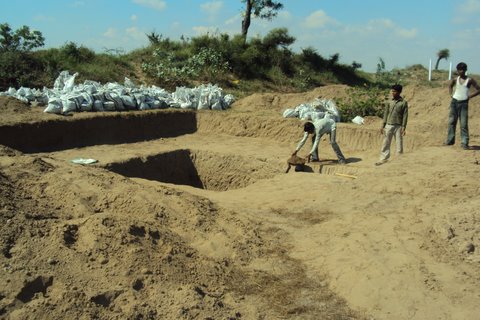
But, in brazen disregard of both the pending case as well as the rejection of the CRZ clearance, the project authorities initiated construction of the project (see picture), with land-filling and cutting of trees. They have also announced a Bhoomi Pujan to ritually inaugurate the construction of the project. The lack of a functioning tribunal, thus, is turning into a free pass for project promoters who knows that there is no forum in place where their plans can be challenged.

The irony - tragedy, actually - is that while company officials move ahead confidently, the local fisherfolk opposing all this are left with no clear agency to approach with their concerns, with the NEAA now formally dead, and the NGT yet to be meaninfully alive. Justice delayed, for petitioners like them, may turn into justice denied.

Kanchi Kohli
29 Nov 2010

Kanchi Kohli is based in New Delhi and a member of the Kalpavriksh Environmental Action Group.

Monday, November 29, 2010

No CRZ nod, but work begins on OPG plant


The article below was published in the Indian Express, November 27, 2010.

Fishermen opposed to power plant in Kutch write to Jairam Ramesh, seeking urgent help

Adam Halliday, Nov, 27, 2010.

When OPG Power Gujarat Private Limited inaugurated its yet to be built 300 MW power plant at Bhadreshwar Village in Kutch District on Saturday, little did the company officials know that local fishermen had written Union Environment Minister Jairam Ramesh twice, pointing out that the company is breaking the law by beginning work before getting full clearance.

A company official said the "Bhoomi Pujan" (foundation laying ceremony) was held although they had not received all the clearances but added they have submitted fresh proposals that would eventually be accepted.

The clearance here refers to a CRZ (Coastal Regulation Zone) clearance that is yet to be obtained from the Union Ministry of Environment and Forests' Expert Appraisal Committee on Coastal Regulation Zone.

In July, the committee had rejected the OPG plans to build an open intake and outlet channel that would ferry seawater to cool the coal based power plant, saying it would adversely affect the marine ecosystem.

Although OPG later submitted proposals for a closed channel, minutes of the CRZ committee's meeting to date (the last one was held on November 9th) show that no go ahead has been given as yet, an anomaly that the fishermen pointed out to Jairam Ramesh's ministry in their first letter on November 21st.

They had also attached pictures of what they said were OPG's construction activities, such as tree felling, a cache of concrete presumably for future construction and square holes being dug, although the authenticity of these pictures could not be independently verified.

A company spokesperson based at Gandhidham in Kutch said, " We don’t have the CRZ clearance as yet, but we have submitted fresh proposals for a closed channel. We are sure that the CRZ committee would accept this. Besides, the channel would only be built two years from now, after the construction of the plant itself is finished,"

Interestingly, the Gujarat Pollution Control Board had cleared the 300 MW power plant on June 6th, 2010 laying down several conditions, one of which was that no construction should take place before all the requisite clearances were obtained.

"The project proponent shall not start any construction/project enabling activities unless and until environmental clearance as well as all requisite prior permissions/clearances are obtained. " the GPCB had said in its letter where it granted the company environment clearance.

But the fishermen's second letter to Ramesh, sent on November 25th, counters this argument, saying construction before clearance is illegal and that this could set a dangerous precedent if it is not stopped immediately.

"Unless the Ministry takes action on the OPG group for its blatant violation of environmental laws, the project proponent will be emboldened to continue with this mockery of environmental laws and this would be a precedent for other industries in the area to treat environment laws with a pinch of salt", the fishermen told Ramesh.

Where do we go? fishermen ask Jairam

In their letter, the fishermen have asked Jairam Ramesh as to which body they should appeal to now that the National Environment Appellate Authority has been disbanded and the National Green Tribunal has not yet begun operations.

The fishermen had approached the NEAA in August contesting the clearance the GPCB had given to OPG. The first hearing was held on September 24, in which the second hearing was scheduled for October 20th.

But on October 18th, two days before the hearing was supposed to have taken place, the NEAA was dissolved since the National Green Tribunal Bill 2010 was passed by parliament and would soon be setup.

Gathering Storm by the seaside

Of the several demonstrations against the OPG power plant, at least one turned violent in August 2009 and six men spent a month in jail. OPG officials, however, claim the opposition is confined to a small group of fishermen.

The locals, mainly fishermen and saltpan workers in the nearby villages who fear their fishing grounds and salt pans would be destroyed by the industrial activity, had taken out a procession at the public hearing for the plant in May last year as well.

But OPG officials claim at least 500 locals, including the company employees and employees of partner companies, had attended the Saturday inauguration ceremony where chhole batura, tea and coffee were served.

Tuesday, November 23, 2010

Local community seeks stay on activities of OPG power project in Bhadreshwar

Representatives of fishworkers, salt pan workers, farmers and residents of Bhadreshwar village of Mundra Taluk, Kutch district have sought the urgent intervention of the Environment Minister on the construction of the 300 MW OPG power plant.

They have complained that that the project authority has undertaken construction of the project without requisite permissions and also cut several trees despite rejection of clearance for the intake channel for the power plant by the CRZ committee in July 2010.


The leaders have pointed out the delay in justice due to the non-functionality of the NEAA (National Environment Appellate Authority) since 18th October 2010. They have filed a case before the NEAA challenging the environmental clearance to the OPG project on clear issues of process an and irreparable impacts. The livelihoods of the local communities and ecological concerns are at stake as the project authority has initiated construction of the project despite the pendency of the case before the relevant authority.

What is ironic is that there is delay in justice being delivered because it is now a month since the NEAA has been discontinued and we don't have a functional National Green Tribunal (NGT) wherein this matter needed to be transferred for hearing. If the project authorities are allowed to construct the project despite lack of all clearances and no appellate authority or tribunal for redressal, it will be gross injustice to the local concerns and livelihoods of traditional fisherfolk of the area and fragile coastal ecosystem. Fishermen are concerned that a fait accompli situation might arise by the time their appeal is heard before the relevant authority.

Tuesday, November 2, 2010

A Gujarat fishing system struggles for survival

Adam Halliday, Indian Express : Tue Nov 02 2010, 06:11 hrs

Bhadreshwar : Near a small village named Bhadreshwar on the Kutch coast, an area almost the size of Gandhinagar disappears and reappears, twice a day. The Randh Bander — also called Mota Bander by the local fishermen because of its size — is a low-lying stretch of flat land that stretches for more than 20 km from east to west and 4 km from north to south (at its widest point). During high tide, seawater covers this entire area — sometimes as deep as 15 feet at some areas. During low tide, the mud is soft but hardy enough to walk on easily, although in some places one may sink till the ankles. It is here that about 650 fishermen’s families from Bhadreshwar and Luni villages have been practising what is called “pagadiya fishing” — where boats are not used but rather fishing is done on foot — for an estimated four centuries.

But the fishermen fear all this may disappear soon. They have been writing and protesting to local, state and Central authorities, including Union Environment and Forests Minister Jairam Ramesh, to stop industries from being set up nearby. One of the reasons is that they fear industrialisation in the vicinity would mean this ecosystem, and the livelihood it offers, will perish.

Pagadiya fishing is a simple affair. Fishermen walk far into the bander during low tide and erect nets upon sticks planted into the mud. As the high tide covers the bander, fish from the Arabian Sea swim onto the algae-rich area and feed there. As the water recedes during low tide and the fish with it, they get caught in these nets. All the fishermen have to do is walk upon the bander and collect them.

On an October afternoon, 42-year-old Osman Jamutar was planting a row of sticks on the mud to form a long and steady arch, busily tying a 400 m net to the sticks. Putting two fingers in between the weave of the nets, he explained the small fish could easily pass through it. “We make sure the small and baby fish escape so that the entire fish population does not die and it allows reproduction,” he said, adding that government agencies like Marine Product Export Development Agency were instrumental in spreading awareness about sustainable fishing.

Jamutar sets up this arching net twice every day, in the morning and afternoon. He goes home to his village and returns when the high tide has come and gone. He normally returns to a crowd of fish, caught in the nets. He wraps these up in the net itself, mounts them onto his bicycle and rides home, where his wife and the women in his family sort the catch and take them to the village market. The wives and female relatives of those pagadiya fishermen who have licenses from the Fisheries Department sell their catch in the towns nearby — Mundra, Adipur, Gandhidam and Anjar.

Pagadiya fishing is practised in villages Surajbari, Cherawadi, Navinad, Jarpara, Shekhadia, Luni, Bhadreshwar, Phirsangar, Wandhi, Lakhpat, Jakhau along the Kutch coast.

What kind of fish do they catch? Jamutar gives a long list: “Gandhia, Chhodi, Crabs, Khokri, Khagi, Khetar, Kunga, Bhufari, Serkhundra...”

As one steps onto the bander during low tide, one comes across crabs peeping from under the wet, sandy surface, tiger prawns burying themselves not far away, even several mangrove saplings.

Ibrahim Sale Manjalia, 61, bends down and runs his fingers over the mud to show a thin, green film over it — algae deposits. “The fish come and eat this,” he explains, and points to a shallow stream that runs from the land towards the ocean. “Those bring food for the fish from the land.”

Ibrahim spent a month in jail last year, as he was arrested with five others when protests against a proposed power plant near the village turned violent. He was one of the leaders of those protests, rallying villagers with songs he had composed.

The streams he shows are the lifeline of this ecosystem. Originating inland, they flow towards the Gulf and deposit minerals onto the mud of the bander, serving as feed for the fish, crabs and prawns that thrive there.

Building industries inland may result in these creeks getting blocked and cutting off this supply.

As we walk towards the Arabian Sea, we come across a V-shaped, 3 km long, 6 ft tall net being put up by three men and three women, hurrying to finish the entire length before sundown. This giant net, which the fishermen call “wall net”, will stand for eight months, unlike the shorter one that is set up and removed daily. When we ask the fishermen how much this “wall net” would catch, one of them answers reluctantly: “Maybe Rs 1,500 worth in one week.”


Saturday, September 11, 2010

OPG power plant hits a hurdle as fishermen raise environmental fears

Adam Halliday, Indian Express, Sept 11th, 2010

The construction of a 300-MW coal-fired power plant at the coastal village of Bhadreshwar in Kutch district hangs in balance as the project of OPG Ltd — a British company with subsidiaries in India — has hit a couple of roadblocks.

While the Union Ministry of Environment has rejected its proposal of seawater inlets and outlets on environmental grounds, a local fishermen association has approached the National Environment Appellate Authority (NEAA) challenging the environment clearance the company had obtained in June.

The clearance was given by the Gujarat Pollution Control Board on June 6. But the fishermen have challenged it on the grounds that the project would affect the marine life. The matter will be taken up on September 24.

In July-end, the ministry’s Expert Appraisal Committee on Coastal Regulation Zone rejected OPG Ltd’s proposals to build multiple pipelines to draw in seawater to the plant, which would be used as a coolant and later released back into the sea.

Rejecting the proposal, the committee cited several reasons. It said the proposal was for an open channel in the CRZ area, and would have adverse impact on the marine life since the released water would raise the temperature of the surrounding water. The panel further held that the construction would also damage mangroves in the area.

The committee’s contentions about marine life being affected by the release of hot water into the sea.

In January, the deputy commissioner (Fisheries) had written to the Kutch district collector, asking him to cancel a public hearing for the OPG power plant. “I would like to respectfully inform you that the local fisherfolk and fishing is likely to be affected by the OPG power plant... Bhadreshwar is an important location for fisheries. Also, there is a proposal to develop a fish landing centre there,” read the letter.

A company spokesperson, meanwhile, said that fresh proposals have been drawn up and submitted to the authorities, but a final call on this has not been taken yet.

Friday, September 10, 2010

Bhadreshwar Fisherfolk win another small victory; vow to fight to the finish

The Bhadreshwar fisherfolk welcome the decision by the central CRZ committee to reject the CRZ clearance for the intake channel for the proposed 300 MW OPG power plant in Bhadreshwar. In the 89th Meeting of the Expert Appraisal Committee for Building Construction, Coastal Regulation Zone, Infrastructure Development and Miscellaneous projects held on 21st - 23rd July, 2010 at New Delhi, the committee noted “Due to various environmental problems including the adverse impact on the marine life the present proposal is not acceptable.”

The committee has also expressed its concern that the intake channel will affect mangroves and sand dunes in the area. This comes as a relief for nearly 6000 fisherfolk who carry out fishing by traditional methods on the sand bar – Randh Bander on the Bhadreshwar coast.

The committee has suggested that the company must consider a pipeline instead of a open channel.

The battle for the local communities is far from over. Since May 2009, the local communities have been opposing the OPG power plant in Bhadreshwar as it will badly affect their livelihoods.

Community leaders feel that even though the State Government agencies came forward to assess public opinion, no one has thought it fit to provide feedback to the local communities on how the company has responded to their issues. Without any further intimation to the local communities, the environmental clearance was provided in a hush hush manner, which raises suspicions whether the State Government authorities have colluded with the company.

The fisherfolk, aggrieved by the arbitrary decision of the state expert committee to grant environment clearance for the power plant, have decided to approach the NEAA (National Environment Appellate Authority) to challenge the clearance. The hearing is scheduled on 24th September, 2010.

Wednesday, March 31, 2010

Environment Ministry’s positive action to streamline norms for Expansion of Thermal Power Plants

The issue: (Excerpt from the article OPG POWER PLANT Environment clearance: A sham again by Kanchi Kohli, a member of the Kalpavriksh Environmental Action Group)

The application for environment clearance for this 300 MW power plant is currently pending with the Gujarat State Environment Impact Assessment Authorities (SEIAA) and its appraisal committee. As per the EIA notification 2006, thermal power projects under 500 MW are termed as 'Category B' and need to take permission at the state level. If over 500 MW, whether a new operation or expansion, then approvals will be considered by the Ministry of Environment and Forests in New Delhi. These projects are branded as 'Category A'. In its letter dated 11th March, 2010 the Gujarat State Expert Appraisal Committee (SEAC) has informed the OPG Group that the environmental clearance for the 300 MW power project will be considered only after the company responds in detail to the issues raised by the local communities.

Expansion plans, even before first phase is approved

But even as this application is pending, the OPG group is thinking bigger. On 3 December 2009, the group submitted an application to the MoEF for establishing the Terms of Reference (ToR) to prepare an EIA report for the expansion of the plant from 300 to 2600 MW. In his letter to the MoEF, OPG group's Managing Director, Arvind Gupta makes no mention of the fact that even the 300 MW plant has not yet been cleared.

Under normal circumstances, it is very likely that this would have gone unnoticed. However, MASS activitists filed a Right to Information application and sought out the details. As soon as this came to their notice, a letter (dated 26 February 2010) was sent to the Envirioent Minister Jairam Ramesh, seeking his intervention. It highlights that the OPG group has deliberately tried to mislead the concerned authorities, and therefore their proposal is liable to rejection, as well cancellation of the smaller plant too.

Read the complete article, at http://indiatogether.org/2010/mar/env-bhad.htm

In a positive step in response to this issue, in its circular dated March 22nd, 2010, the Environment Ministry, led by the Environment Minister, Shri.Jairam Ramesh, has taken cognisance of the issue and taken steps to rectify the clearance process. The Ministry has decided that the expansion plan for projects will be considered only after the implementation of the earlier phase has commenced. Also, in case of projects (like the OPG project which applied for expansion to 2600 MW while the clearance for 300 MW project is still pending), for which environmental clearance for the earlier phase has not yet been accorded, the company will have to submit a comprehensive proposal for the entire project by clubbing together all the phases so that environmental issues can be addressed holistically.

The fishworkers and other traditional communities on the Kutch coast and also the Environment Activists welcome this positive step taken by the Environment Ministry and applaud the Environment ministry for its efforts to strengthen and streamline the environment clearance process and view this as one more step towards pro-poor, environment friendly and sustainable development in our country.

Sunday, March 21, 2010

Expert committee tells OPG "Provide Answers to people's issues first, then come to us"

In its letter dated 11th March, 2010 the Gujarat State Level Expert Appraisal Committee has informed OPG that the proposed 300 MW power project at Bhadreshwar will be considered for Environmental Clearance only after the company responds in detail to the issues raised by the local communities and also gets CRZ clearance from the competent authority.

The chronology of events related to the OPG power project is shown below:
29th May,2009 Public hearing for the 300 MW OPG power project witnessed unprecedented opposition from local communities Read More

23rd Aug,2009 Violent incidents in Bhadreshwar as OPG attempts to start construction without environmental clearance. 30 Fisherfolk leaders arrested and jailed for over 3 months. No action taken against the company. Read More

27th Aug,2009 Fisherfolk move Gujarat High Court against OPG project, raising issues of illegal construction and wrong information provided by company during public hearing.Read More

03rd Dec,2009 OPG approaches MoEF for expansion of the 300 MW power plant to 2600 MW.

03rd Feb,2010 Gujarat High Court orders site visit by GPCB officials and rules that company can’t start construction until project gets Environmental Clearance.

24th Feb,2010 Team of GPCB and Expert Committee visits Bhadreshwar and interacts with local communities and company officials. GPCB asks Machimar Adhikar Sangharsh Sangathan, a local fishworkers tradeunion to prepare a comprehensive representation of all issues raised by the local communities in opposition to the OPG project.

4th March,2010 MASS hands over the representation, on behalf of 23,000 Fishworkers, Salt Panners, Farmers, Livestock rearers, Jain pilgrims and other villagers, to Expert Committee in presence of OPG officials.

11th Mar,2010 Expert Committee writes to OPG seeking their response to the issues raised by the local communities and states that project will be considered for Environmental Clearance only after satisfactory response to the issues raised and also the company has to obtain prior CRZ clearance from the central authorities.

12th Mar,2010 OPG starts construction again in project site.

13th Mar,2010 Fisherfolk complain about OPG’s illegal construction activity to district authorities.

17th Mar,2010 Legal notices served to district officials to conduct site inspection of the illegal construction activity.

As on date No action taken by District administration and OPG continues illegal construction activity without Environmental Clearance.

As mentioned in the representation made by MASS to GPCB, the project is likely to adversely impact fishworkers, salt panners, farmers, livestock rearers, Jain pilgrims visiting the Bhadreshwar panch teerth and other villagers of Bhadreshwar and the surrounding villages. On July 10rd, 2009, the Bhadreshwar Gram Sabha passed a resolution against the OPG power project. Villagers are worried because OPG is committing so many violations at the entry stages itself, and if allowed to establish, cannot be relied upon to sincerely implement pollution control measures that are being discussed on paper, thereby putting people's health and livelihoods at risk.

The apathy of the District Administration in ignoring the local community's complaints and allowing OPG to continue with illegal construction means that the villagers only ray of hope lies with the Expert Committee and the courts. The Machimar Adhikar Sangharsh Sangathan, Kutch Zilla Machimar Association, The Bhadreshwar Salt Pan Association, Paryavaran Mitra and Kalyanji Vardhaman Trust (Trustees of the Jain pilgrimage shrine) welcome the positive steps taken by the Expert Committee and GPCB to understand the issues of the local communities. However, it remains to be seen whether the expert committee will take a step further in the interests of the local communities and deliver justice by rejecting the Environmental Clearance for the OPG power project.


If you would like to support the local communities in their pursuit of pro-poor, clean and sustainable development, please sign the following petition to insist upon the environmental regulatory authorities to reject environmental clearance for the project and the district administration to wake up and take some action against the company.
http://www.gopetition.com/online/30272.html

Saturday, March 13, 2010

OPG starts construction without Environment Clearance, yet again, inspite of court order

The Gujarat state expert committee is considering whether or not to grant environment clearance for the 300 MW project, which poses grave risks to the health and livelihoods of local communities and also the tranquility of the 2500 year ancient Jain Vasai Teerth, which is located just 1.5 km from the project site. While the company is claiming that there will be absolutely no impact because of the project, the local communities, which have been mislead and given false information several times, view the company’s claims as hollow promises which are not backed by genuine, systematic and scientific studies, based on consultations with local community.

Local community leaders conveyed their strong objection to the project during the State Expert Committee’s visit to the project site on February 23rd, 2010. An RTI reply sent by Ministry of Environment and Forests revealed that the company has already applied for expansion of the 300 MW project to a 2600 MW project (which the state expert committee was not aware of), raising questions about violation of environment norms which stipulate Central Government permission for Power projects of capacity over 500 MW.

Now, the proposed 300 MW power plant in Bhadreshwar village of Mundra taluk, is in serious trouble once again, as the company has started construction without the mandatory environment clearance. This is not the first time that the company has done this. It may be recalled that the company’s attempts to start illegal construction in August 2009, had led to violent clashes in the village (See http://masskutch.blogspot.com/2009/08/violent-twist-to-hitherto-nonviolent.html).

After the August incident, the local fishermen had also approached the high court to seek intervention in this matter and in its order on 3rd February,2010 the Gujarat High Court ruled “The matter(Environment Clearance for the OPG project) is pending before the Environmental Impact Assessment Authority of the State(of Gujarat) and till Environmental Clearance Certificate is given the 11th respondent(OPG) cannot establish the unit.

However, as the following photographs (dated 12th March,2010) taken at the proposed OPG project site in Bhadreshwar reveal, the company, in gross violation of environment law and is also in contempt of court, has again started construction.


The local communities have approached the concerned authorities for immediate action in this matter.

If you would like to support the local communities in their pursuit of clean and sustainable development, please sign the following petition to insist upon the environmental regulatory authorities to reject environmental clearance and the district administration to take strong action against the company.
http://www.gopetition.com/online/30272.html

Friday, November 27, 2009

OPG's Divide and Rule ploy defeated as Court decides not to withdraw PIL

UK Based OPG Group has been trying to illegally start construction on a power plant in Bhadreshwar village in Mundra coast. British company OPG Power Ventures Plc, or OPG as it is known, has also been accused of breaching environmental laws and being complicit in violations against local people in India. OPG, a power-supply company is planning to build a 300 MW coal-powered power station on the Mundra coast of the State of Gujarat. The Mundra coast is known as an ecologically-sensitive zone, with an abundance of mangroves, corals, and wildlife. The coastal waters also provide the source of income for the ten thousand fishermen who live within 5kms of the proposed plant.

Fisher-folk of Bhadreshwar village had approached the Gujarat High Court in August regarding the OPG Power plant issue. In their PIL, they had explained how the project is not in public interest and the company has been providing false and misleading information to the public/ Govt authorities. They also alleged that the company has been trying to start construction work illegally even without the mandatory Environmental Clearance and the district administration has remained a mute spectator to the company's violations inspite of repeated complaints from fisherfolk and other local communities. The fisher-folk have prayed that the Hon. High Court put an end to all these illegal activities of OPG group.

Realising that their game in Bhadreshwar is about to end, the OPG group has been allegedly resorting to various unfair and unethical means to subdue the fisherfolks' struggle.

Several fishermen, including those who were not present during the clashes in August, have been falsely implicated in criminal cases and jailed for over 2 months.

In the second week of Nvomenber, the president of the Kutch Zila Machimar Association, Suleiman Ali, wrote to the fisherfolks' advocate and 11 other authorities, including the OPG company asking for withdrawal of the PIL. Quoting him from his letter(written in English), "I have come to the conclusion that the scope of the OPG Power project at Bhadreshwar and the implementation and the operation of the project will not effect any fishermen and / or members of our association and people living in Bhadreshwar and surrounding villages and their villagers". Fishermen wonder, who wrote this letter in Corporate Style English for Suleiman Ali who doesn't know English.

Angered by this letter, fishermen representatives attended court yesterday(26th Nov) and submitted an affidavit saying that their PIL needs to be pursued in the interest of 23,000 people. Quoting from one of the affidavits, "I have come to know that our President Shri.Manek Haji Suleiman Ali has, against the inteest of about 23,000 people, joined hands with OPG Company and written a letter asking for withdrawal of the PIL. We have not given any authority to Sulieman Ali to withdraw the PIL. The people of our village are against OPG Power project. All of us want to pursue the PIL in the interest of justice and interest of village people"

During the hearing, the Government Advocate(on behalf of Kutch Collector) court submitted Suleiman Ali's letter and argued that the PIL be withdrawn. But, the court accepted the Fisherfolks' argument that the company was trying the "divide and rule" ploy and one man's betrayal cant stand in the way of larger public interest and the lives and livelihoods of nearly 23,000 people. Favoring the fisherfolks' plea to allow the PIL to continue, the court has issued notices to all respondents, including OPG.

Wednesday, August 26, 2009

Violent twist to the hitherto nonviolent struggle by Fisherfolk against OPG power plant

Click here Sign a Petition to urge the Government officials to stop the illegal and fraudulent activities of OPG Power Plant.

Fisherfolk in Bhadreshwar village and nearby villages have been opposing the 300 MW OPG power plant proposed in Bhadreshwar Village for several months. The local communities mainly feared the harmful impact of the power plant upon their health and livelihoods and the company’s EIA report created grave concern about loss of livelihoods of nearly 20,000 fisherfolk and salt pan workers. See Likely impact of Industries on Fishing

The public hearing for the Environment Clearance of the project held on May 29th 2009, witnessed unprecedented opposition by Fisherfolk, Salt pan workers and other members of the local communities. After the public hearing, several representations have been made to various authorities such as the GPCB, MoEF highlighting the fraudulent methods being used by OPG in order to get Environment Clearance for the project. See Public hearing for OPG Power Project in Bhadreshwar village, 29th May, 2009.

Since July, the fishing community had been put under lot of pressure due to several attempts by OPG to start construction activity even before Environmental Clearance was given for the project. On August 5th, several trucks arrived at the project site and they were gently asked by representatives of the Fishing community not to start construction as clearance had not yet been obtained. A Letter was issued to the local Panchayat to ensure that no construction is started without Environmental clearance.

However, the company made another attempt on August 9th to start construction and this time brought private security guards with them. The representatives of the fishing community got legal notices issued to the company not to start construction without clearance and to government officials not to abet the unlawful activities of the OPG group. See Community Gears up to Stop Illegal Activity by OPG Power Plant

Inspite of these efforts, no action was taken by the Government authorities to enforce law and the company, in its desperation to start construction hired and stationed 15 persons from the local community as security guards in the project site on August 22nd. This led to a clash on August 23rd between member of the fishing community and the security persons, which led to 7 people getting injured and two motorcycles being burnt. Among the persons injured were four members of the Fishing community, 2 members of Luni village, and 1 person from Bhadreshwar village.

In response to a complaint filed by the father of the injured person from Bhadreshwar village, the Mundra police have arrested 31 persons from the Fishing community.

Saturday, August 22, 2009

Community Gears up to Stop Illegal Activity by OPG Power Plant

Click here Sign a Petition to urge the Government officials to stop the illegal and fraudulent activities of OPG Power Plant.

The proposed 300 MW coal based thermal power plant promoted by M/s OPG Power Gujarat Pvt Ltd. in Bhadreshwar Village, Mundra Taluka, Kutch is not in public interest and being opposed by representatives of the affected local community due to the following reasons:

1. The company has tried to hide the impacts of the project by misguiding the public and the authorities about the location of the project and falsely stating in their EIA report that there is no habitation with 5 km radius of the power plant and that the nearest village Bhadreshwar is 5 km away from the project. But, in reality, air and water pollution from the power plant is likely to

a. Detrimentally impact the health of 20,000 villagers who live within a 5 km radius of the power plant
b. Affect marine life and affect the livelihood of 6000 fisherfolk residing on Randh Bander, which has the second highest Fish production in Kutch.
c. Pollute the salt manufactured in salt pans adjacent to the power plant thereby rendering the salt unfit for consumption or sale and depriving the salt pan owners and nearly 13,000 salt workers of their livelihood
d. Affect ancient historical and religious sites in the area, i.e. the Chokhand Mahadev temple, the 1500 year old Jain Vasai temple and pilgrimage centre and the Dargah Sharif, all of which are located within a 5 km radius of the power plant.
e. The project will also negatively impact the reserve forest area and a fledgling afforestation project being carried out by the Adani group, both of which are located within a 5 km radius of the power plant.

Thus, the company claim that there is no habitation in 5 km radius of proposed power plant is totally false and an attempt to mislead the authorities. See below the map of the 5 km radius area of the power plant.

* Click on the image to see the full size image.


2. The company has violated the provisions of the EIA Notification by submitting a false and misleading EIA report. The EIA report attempts to mislead the people and the Hon’ble members of the Environment Clearance committee both as to the location of the thermal power plant as well as its true impact on the health and livelihood of the local community and the environment.


3. The project is proposed to be set up in a CRZ area which is impermissible under the provisions of the CRZ notification, without prior clearance from Ministry of Environment and Forests.

The project faced strong opposition during the public hearing held on May 29th, 2009, See Public hearing for OPG Power Project in Bhadreshwar village, 29th May, 2009.

Detailed Memoranda have been sent to the Gujarat Pollution Control Board and MoEF officials, and also Honorable Minister of Environment and Forests, Shri.Jairam Ramesh with full details of the above issues seeking rejection of Environment Clearance for the Project.

While the local community is vehemently opposing the project for the above reasons, the company officials are violating Environmental laws by attempting to start construction of the project even before the GPCB clears the project. Legal notices have already been issued to Company officials not to start construction without Environmental Clearance and to the District administration not to abet the unlawful activities of the Company.

Thursday, June 18, 2009

Sign a Petition to stop the displacement of Fisherfolk

Click here and leave us a comment with your name or email id, location to show your support for our demands.

Your support will help us to insist upon the Government and Industry to accept our demands.

Write to us at mass.kutch@gmail.com

Friday, May 29, 2009

Public hearing for OPG Power Project in Bhadreshwar village, 29th May, 2009.

The public hearing for EIA clearance for OPG’s power plant in Bhadreshwar was held on 29th May 2009. The venue was Chokhanda Mandir, Bhadreshwar village, Mundra Taluk. The Gujarat Pollution control Board Regional Officer, J.D.Kalyani and Kutch Additional Collector Shri.Vaghela chaired the meeting. OPG project director Mr.Padmanabhan and company officials were present. Also, officals from Detox corporation, the Surat based agency that carried out the EIA were present.


A huge number of people numbering over 2000 persons from affected villages participated in a 2 km rally which ended in the venue of the public hearing. This included traditional fisherfolk, Salt pan workers, Pastoralists, farmers and other villagers from Bhadreshwar, Sangad, Wandi, Luni, Hatdi, Pavdiara and other villages, likely to be affected by the project. The venue was filled to capacity and there were more people waiting outside trying to participate in the public hearing.


Shri.J.D.Kalyani gave an outline of the environmental clearance process. The project details were presented by an official of Detox corporation. After his presentation, several locals held the mike and explained their view on the project, listing out various issues in the proposed power plant.


The issues are listed below:

  1. MASS Leaders raised the issue of the fisherfolk. Randh Bhadreshwar Bander, which is situated 5 km from Bhadreshwar village and home to over 5000 fisherfolk has not been mentioned anywhere in the OPGs’ report, which is supposed to provide details of habitations in a 10 km radius. In fact, as per the latittude- logitude of the power plant provided in the EIA report, the power plant is coming up exactly on Randh Bander. Since 2004, the fisherfolk have been submitting memoranda to the district administration to recognize the Bander land as a Fish landing centre. A Gujarat Government report of 2004 recommends that the Randh Bander be developed into a modern fish landing centre. In this situation, the OPGs are planning to install a power plant and a desalination plant which will discharge pollutants in the air, highly saline water and warm water into the sea, which will affect the marine ecology. Fishing is the sole occupation of the traditional fisherfolk and deprived of it they will perish. To pacify the fisherfolk, the company officials promised to provide water to the fisherfolk from the desalination plant. But, the fisherfolk were unanimous in opposing the OPG power project and exclaimed, “We will bear lathi and bullets, but we will not let the OPGs near our land ”.

  1. Villagers of Bhadreshwar dismissed the claim that the OPG power project is 5 km away from the nearest habitation. Within 5 km of the power project are the 5000 fisherfolk in Randh Bander, Bhadreshwar village with a population of over 6000 and over 5000 salt pan workers. Also, as per revenue records, the land on which the power plant is proposed, has not yet been procured by the OPGs. Local villagers asked, “When the land is not yours, how can you seek permission to build something on it?”. The company officials had no reply to these questions.

  1. There are nearly 5000 acres of salt pans in the area around the proposed power plant. The salt pans produce over 5000 tonnes of salt every month valued at over 15 crores. Already, the salt pans are facing difficulties due to pollutants that emerge from industries, 10 kms away, that burn around 400 tonnes of coal per month. Now with a power plant hardly 2 kms away, that burns around 90,000 tonnes of coal per month, the salt pans will be seriously affected and the salt produced will be unsuitable for consumption and the salt pans will be forced to close down. Bikha Bhai, speaking on behalf of the salt pan association stated, “We have been pursuing our traditional livelihoods for decades. Now this project is threatening to snatch our livelihoods from us. We are against this project and our fight will not stop with this public hearing. If the project is cleared at the state level, we will go to the central government. If it cleared there, we will go to the courts. If it is still cleared, 10,000 of us, including salt workers and fisherfolk in this area will lay down our lives before this project is implemented”.

  1. Traditional pastoralists also opposed the project on the grounds that the project will adversely affect them and their livelihoods.


  1. The Sarpanch of Bhadreshwar viillage, Shri.Umar bhai took a strong stand against the project, on behalf of all the communities in Bhadreshwar Village. He said that companies like OPG state that they will take precautions, but in our experience, nothing is done in reality to protect the local environment. He quoted the example of the Adanis who had given several promises but nothing was implemented. He stated that this is not a question of Hindu-Muslims, the entire village is with the fisherfolk and united in opposing the OPG project.
  2. As a sign of their Gandhian protest against the OPG power project, none, not even one of the 2000 people touched the food, not even water that was kept next to the venue, in a OPG food stall which looked deserted.
  3. Soni Ben from lok Adhikar Manch said that widows in the area had been long demanding for 5 acres of land each, from the collector. But the collector refuses to even meet them But, when industries ask for land, the collector eagerly agrees to their demands. She said that the project will be of no use to the village and hence she is against the project.
  4. Smt. Usha Ben Thakkar, ex-MP, Kutch, who had served on the Fisheries board condemned the plan to build the power plant in Bhadreshwar, stating that fisheries will be badly affected. Other leaders like Shri.Haresh Thakker, Dalit leader Shri.Valji Bhai opposed the plan to construct the power plant in Bhadreshwar and suggested that the p[ower plant be constructed in Little Rann of Kutch or other barren lands which were available in plenty in Kutch.
  5. Panchayats of eleven affected villages submitted letters opposing the OPG project.


Even though the hearing was held on a Friday, a holy day for muslims, hundreds of muslim fisherfolk turned up at the hearing to raise a voice to protect their livelihoods. At the end of the meeting, the people from Bhadreshwar and neighbouring villages shouted, “We will give our lives, but not our land” in a clear and unanimous message to all the authorities, the OPG company and the Government that the people are not in favour of the project and they will strongly oppose any move to implement the project.